Aerospace manufacturers increasingly need components that combine low weight, intricate geometry, thermal performance, and reliable mechanical properties. Conventional machining can struggle with internal channels, lattice structures, and highly integrated designs. Metal additive manufacturing offers another route, but selecting the right process requires more than comparing laser power or build size. NASA notes that metal AM process selection depends on geometry, metallurgical characteristics, cost, post-processing, and process maturity.
Why Laser Powder Bed Fusion Fits Complex Aerospace Geometry
Among metal additive manufacturing technologies, laser powder bed fusion (L-PBF) is particularly relevant when manufacturers need detailed and complex metal parts. The process selectively melts layers of metal powder with a laser, repeating the cycle until the component is formed. NIST identifies powder bed fusion as a technology capable of producing functional metal parts and complex geometries.
This capability is valuable for aerospace components because designers can integrate features that are difficult or expensive to produce through conventional subtractive manufacturing. NIST specifically notes applications of metal powder-based fusion in aerospace and other industries where complex or low-volume functional parts are required.
L-PBF can also support lightweighting and part consolidation. Aerospace research has highlighted applications involving cooling structures, turbomachinery, heat exchangers, valves, and propulsion components, where additive manufacturing can create integrated geometries while reducing material use and assembly requirements.
Comparing Laser Metal 3D Printers for Production Requirements
For buyers evaluating 3D metal printers, laser configuration is an important consideration. A single-laser system can provide controlled processing for many applications, but production requirements may justify a multi-laser architecture when larger build areas and higher productivity are needed.
A multi-laser system can divide scanning work across multiple laser sources. However, simply adding lasers does not automatically guarantee consistent production. Scan strategy, calibration, energy distribution, software, and process control must work together to maintain predictable results across the build area.
This is particularly important for aerospace production, where repeatability and process control can be as important as throughput. SAE International’s AMS7003A establishes process controls for repeatable production of aerospace parts using laser powder bed fusion, demonstrating the importance of controlled manufacturing processes rather than laser power alone.
Where the LiMN 3D LM-M400 Fits
LiMN 3D, backed by Linmu3D’s laser-industry experience, focuses on SLM metal additive manufacturing equipment for fields including aerospace, healthcare, dentistry, mold manufacturing, and precision processing. Its product range includes the LM-M100D Lite, LM-M120D Lite, LM-M150, LM-M280, LM-M400, and LM-M800, covering different industrial production requirements.
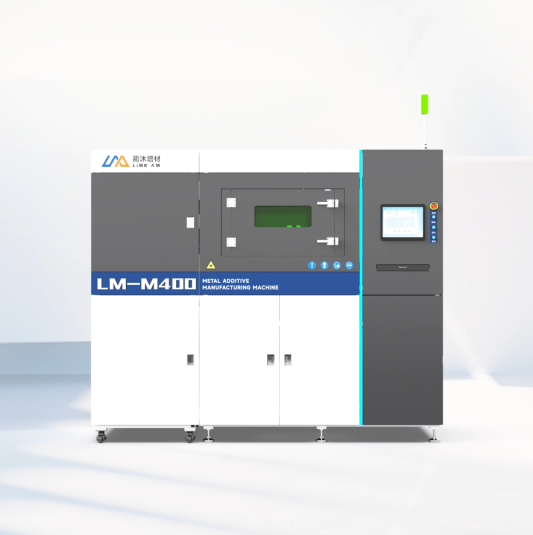
For applications requiring a larger production platform, the LM-M400 adopts metal powder bed melting technology and uses a quad-laser configuration with four 500 W lasers. According to the supplied product specifications, its maximum forming efficiency reaches 140 cm³/h. Its XY-axis forming size is also positioned as particularly large within its comparable product class.
The four lasers are designed to achieve full coverage of the build area through a coordinated scanning strategy. The stated approach focuses on uniform energy control across the forming area, which is relevant when manufacturers need to maintain stable processing conditions while increasing production efficiency.
The LM-M400 also uses an enclosed powder circulation loop and short sieving times for large powder volumes. The process chain can operate under a protective gas atmosphere, including sieving, printing, cooling, and de-powdering. For industrial users, this design addresses both production efficiency and operational handling requirements.
Another consideration is process and software control. LiMN 3D states that the LM-M400’s software, algorithms, and control system are independently developed by Linmu3D. The system provides open process parameters and supports personalized customization, giving manufacturers more flexibility when developing production processes for different applications.
The manufacturer’s published general specifications list the LM-M400 at 2960 × 1270 × 2500 mm, with a 20–120 μm layer thickness range and 380 V, 34 kW power consumption. These specifications should be considered alongside the required part envelope, material, production volume, and facility infrastructure when evaluating equipment.
Matching 3D Metal Printers to Aerospace Workflows
Choosing among 3D metal printers should start with the part rather than the machine. Engineers should consider the required geometry, material, dimensional requirements, production volume, post-processing route, and qualification needs.
L-PBF is particularly suitable when intricate internal and external features are central to the design. NASA describes L-PBF as offering high feature resolution and the ability to produce complex internal and external geometries, while also noting limitations such as build-envelope constraints and relatively low deposition rates compared with some alternative processes.
Directed energy deposition (DED), by comparison, can be more appropriate for larger structures, repair, or applications where deposition rate and material addition are prioritized. NASA emphasizes that there is no universal metal AM process for aerospace; selection depends on the specific component and its technical requirements.
For buyers considering a laser metal 3D printer, this means productivity should be evaluated together with build coverage, process stability, software control, powder management, and the ability to develop repeatable parameters.
Building a Practical Metal AM Selection Strategy
A sensible evaluation can begin with representative aerospace or complex-part geometries. Manufacturers can assess whether the system provides enough build space, whether its laser configuration matches production targets, and whether its process-control architecture supports the required repeatability.
LiMN 3D’s broader application portfolio includes aerospace, heat exchangers, mold manufacturing, automotive, medical and dental applications, consumer electronics, shoe molds, and research. This range reflects the broader flexibility of metal powder bed systems for organizations handling diverse precision-manufacturing requirements.
Making the Technology Decision
The best laser metal 3D printer for aerospace is not necessarily the machine with the highest nominal laser power. Geometry, productivity, energy control, powder handling, software, process development, and production requirements all influence the final choice.
For manufacturers exploring high-efficiency metal powder bed production, the LiMN 3D LM-M400 combines four 500 W lasers, a large forming platform, multi-laser scanning, automated powder circulation, and independently developed software and control technologies. Those characteristics make it a relevant system to evaluate when complex aerospace and industrial metal parts demand both design freedom and scalable production.
