Paint viscosity can change with shear rate, temperature, and formulation. A tester used for routine quality control may therefore require different capabilities from equipment intended for formulation research or process simulation. Choosing the right instrument starts with understanding how the coating behaves in storage, mixing, application, and final use, then matching those conditions to the measurement range and test method.
Start With the Measurement Objective
The first consideration is not the instrument name, but the type of viscosity information required. Paints and inks are typically non-Newtonian materials, so their apparent viscosity can vary as shear conditions change. Low-shear measurements may relate to storage, leveling, and sagging, while higher shear conditions can better represent two tiers of dynamic scenarios: material handling processes such as pumping and mixing, and coating application processes including rolling, spraying, and brushing.
Research laboratories often need to examine viscosity across a wider range of shear rates. Quality-control laboratories may instead prioritize repeatability, standardized methods, straightforward operation, and efficient data handling. Recognizing that difference helps prevent selection based only on a single viscosity range.
Match the Instrument to Application Conditions
A practical tester should represent the conditions under which the coating is processed or applied. Cone-and-plate systems are useful when high-shear behavior matters because their geometry can generate substantial shear rates with relatively small sample volumes.
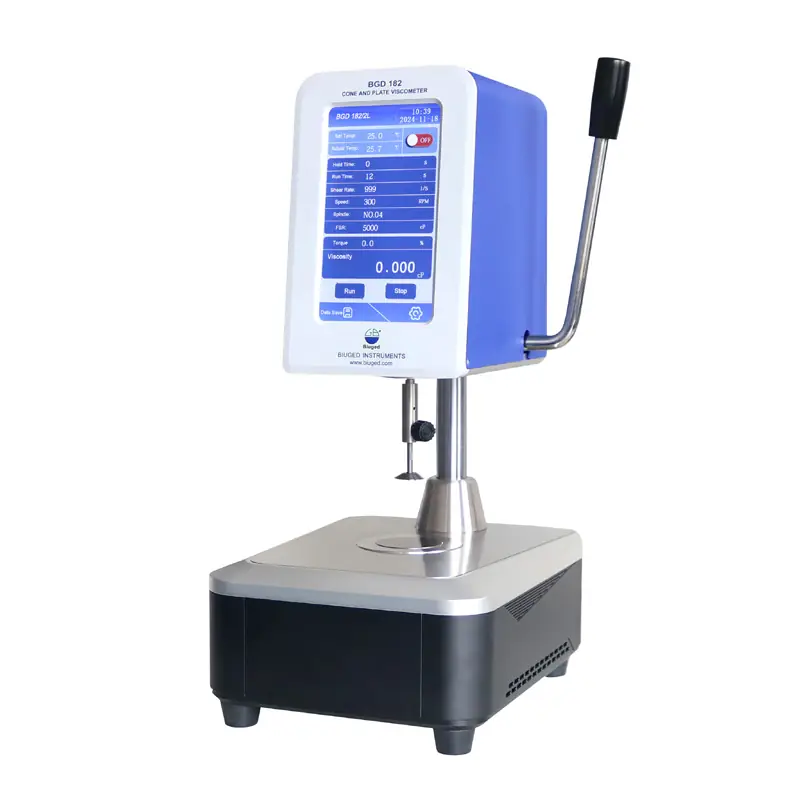
For paint and coating laboratories, a cone and plate viscometer can be considered when high-shear viscosity needs to be characterized in a controlled manner. The BGD 182 uses a special-angle conical spindle and is designed in accordance with ISO 2884-1 for high-shear viscosity measurement of paints and varnishes. Its official specifications show that selected spindle configurations can reach shear rates up to 13,300 s⁻¹.
This can help laboratories relate instrument data to practical application behavior. Instead of relying on a single low-shear value, researchers can examine how a formulation responds under conditions closer to high-speed dispersion, rolling, spraying, or brushing. Within this type of testing workflow, BIUGED INSTRUMENTS focuses on equipment designed to support controlled and repeatable laboratory measurements.
Consider Range, Speed, and Sample Volume
Measurement range is another key selection factor. A laboratory working with primers, architectural paints, industrial coatings, or specialty formulations may encounter materials with very different viscosities. Multiple spindle options can therefore provide more flexibility than a narrow single-range system.
The BGD 182 offers ten optional spindle types and several torque and temperature configurations. Depending on the selected spindle and model, its documented measurement ranges extend from low viscosities to as high as 1,500,000 mPa·s. Its adjustable speed range is 5 to 1,000 rpm, with 1 rpm incremental adjustment, while one spindle option uses a sample volume of just 24 μL.
Small sample requirements can be valuable in research and development, where experimental formulations may be available only in limited quantities. The selected spindle and measurement range should still match the expected sample behavior rather than simply choosing the widest available range.
Account for Temperature Effects
Viscosity is sensitive to temperature, making thermal control an important part of test design. Laboratories comparing materials should minimize temperature variation between measurements, particularly when formulation differences are relatively small.
The BGD 182 is available in low- and high-temperature configurations. The official specifications list 5–75°C for the low-temperature type and 50–235°C for the high-temperature type, with 0.1°C temperature resolution. The low-temperature configuration has a stated control accuracy of ±0.5°C.
Controlled temperature measurement can help research teams distinguish formulation effects from test-condition variation. In quality control, it can also support consistent procedures when viscosity limits form part of a product specification.
Look Beyond the Basic Measurement
A laboratory viscometer should fit the wider testing workflow rather than simply generate a numerical reading. Researchers may need to compare formulations, store results, repeat measurements, or transfer data into other systems. Quality-control teams may place greater emphasis on simple calibration, clear displays, and reliable export functions.
The BGD 182 includes a 7-inch touch screen, menu-based operation, USB data export, a high-precision PT100 temperature sensor, and a built-in temperature calibration function. Its documentation also describes calibration using one bottle of standard oil, while optional software supports data acquisition and programmed rheological analysis.
For laboratories managing different material testing tasks, BIUGED INSTRUMENTS also covers viscosity and other coating-related measurement applications, making instrument selection part of a broader laboratory testing strategy.
Build the Selection Around Standards and Repeatability
Standards should be considered early because the selected method can influence instrument configuration, accessories, and operating conditions. ISO 2884-1 is directly relevant to the BGD 182, while laboratories should also review internal specifications and customer requirements before finalizing a setup.
Repeatability deserves equal attention. Meaningful viscosity data depends on consistent sample preparation, temperature conditioning, spindle selection, speed, and measurement procedure. Even advanced equipment cannot compensate for uncontrolled sample handling, so a documented procedure should be established alongside the instrument.
For laboratories running both R&D and quality-control programs, this approach can also improve continuity between development data and routine verification. A carefully selected viscometer becomes part of a repeatable testing method rather than an isolated piece of equipment.
A Practical Basis for Viscosity Tester Selection
The right paint viscosity tester is determined by measurement objectives, expected shear conditions, viscosity range, temperature requirements, sample availability, and documentation needs. A broader feature set is useful when it directly supports the laboratory’s actual workflow.
The BGD 182 combines high-shear measurement, multiple spindle options, temperature-control configurations, calibration functions, and digital data handling in a platform designed for standardized viscosity testing.
For laboratories evaluating new viscosity testing equipment, BIUGED INSTRUMENTS provides detailed product specifications, application guidance, and tailored configuration support to help you align equipment capabilities with your specific testing requirements.
