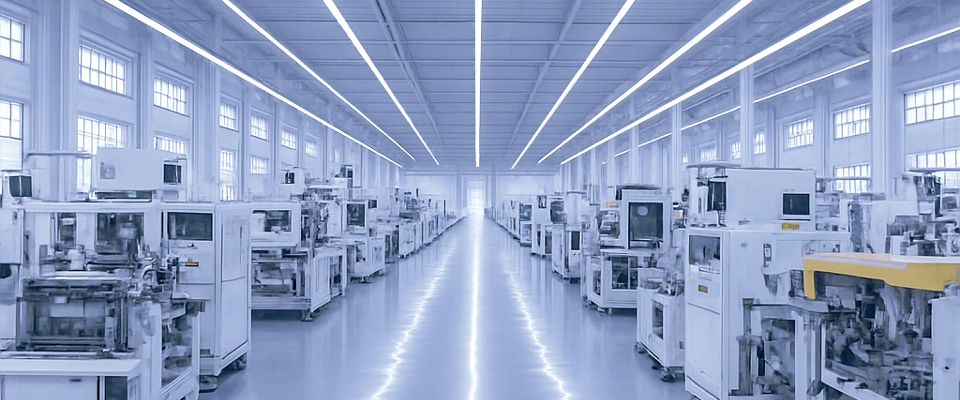
Selecting appropriate illumination technology for commercial or manufacturing facilities requires a systematic evaluation of energy efficiency, ambient conditions, and structural compatibility. Implementing comprehensive LED lighting retrofit solutions enables property managers to drastically reduce operational expenses while improving visual acuity across work areas. Modern solid-state luminaires provide continuous, flick-free illumination that enhances workplace safety and productivity.
Heavy-duty environments present unique challenges like high ambient temperatures, vibration, and airborne particulate accumulation. Facilities seeking specialized industrial lighting equipment benefit from exploring modular fixture architectures engineered for harsh conditions. TRIECO offers different retrofit options for specific applications, including trunking retrofit modules, compatible linear track systems, and IoT LED tri-proof luminaires for parking facilities.
Assessing Existing Electrical Infrastructure and Fixture Layouts
Planning an illumination upgrade begins with a thorough audit of current circuit capacities, voltage stability, and fixture spacing. Legacy HID or fluorescent systems often utilize wiring topologies that can be repurposed to support low-power solid-state fixtures, avoiding costly re-conduiting. Analyzing foot-candle distribution across different operational zones identifies areas requiring higher lux levels.
Evaluating mounting heights and ceiling clearance helps dictate beam angles and luminaire form factors. High-bay spaces require narrow optical distribution to drive light downward efficiently, whereas low-ceiling storage rooms require broad dispersion profiles. Mapping these physical constraints establishes the technical baseline for selecting proper replacement hardware.
Ingress Protection and Environmental Resistance
Industrial facilities often expose electrical components to high humidity, dust, chemical vapors, and pressure washing. Where fixtures are exposed to significant dust or moisture, an appropriate IP rating such as IP65 or IP66 may be required based on site conditions. Sealed enclosures protect sensitive drivers and LED chips from airborne contaminants.
Selecting specialized industrial lighting hardware ensures long-term operational stability in harsh environments. Enclosures constructed from impact-resistant polycarbonates or extruded aluminum prevent housing fractures caused by accidental machinery impacts. Sealed, dust-tight designs maintain optical clarity without requiring frequent internal cleaning.
Photometric Performance and Visual Ergonomics
Visual clarity directly impacts worker safety, task precision, and overall operational efficiency. High-performance luminaires must deliver high Color Rendering Index (CRI) values and uniform light distribution to eliminate deep shadows in hazardous working zones. Reducing harsh glare prevents eye strain for equipment operators working long shifts.
Integrated optical lenses control light spread to prevent light pollution in non-work areas while maximizing illuminance on task surfaces. Deploying high-efficiency LED lighting retrofit solutions allows facilities to achieve required lux metrics using lower overall wattage. Proper photometric design turns raw lumen output into functional visual comfort.
Modern Engineering and Modular System Selection
Modern facilities demand flexible illumination setups that can adapt to changing production lines or warehouse rack layouts. TRIECO offers modular trunking and track-based lighting solutions with different installation structures for industrial, retail, and office applications. Modular hardware speeds up initial deployment and simplifies future spatial reconfigurations.
Standardized electrical trunking allows lighting, emergency backup modules, and smart sensors to click into a single continuous profile. Streamlined installation lowers labor hours and minimizes production downtime during facility overhauls. Universal mechanical mounting options ensure seamless fitment across varied ceiling structures.
Smart Lighting Controls and Energy Optimization
Integrating intelligent control networks unlocks the full energy-saving potential of solid-state systems. Ambient daylight sensors automatically dim fixtures near skylights and perimeter windows, balancing artificial and natural light dynamically. Occupancy sensors ensure unoccupied aisles and storage bays remain dimmed or powered down until motion is detected.
Deploying IoT LED Tri-proof Luminaires from TRIECO combines ruggedized physical protection with smart network connectivity. Integrated radar sensors and Zigbee modules support sensor-based control and intelligent lighting management in parking facilities. Automated scheduling and granular control significantly lower monthly utility expenditures.
Thermal Management and Driver Reliability
Heat accumulation remains the primary driver of LED diode degradation and premature electronic failure. High-grade aluminum heat sinks draw thermal energy away from semiconductor junctions, preserving lumen output over tens of thousands of operating hours. Efficient thermal dissipation prevents color shifting and maintains driver efficiency across variable ambient temperatures.
Quality drivers feature built-in surge protection, low total harmonic distortion, and high power factor ratings. Reliable power conversion electronics guard fixtures against line voltage fluctuations common in heavy industrial facilities. Effective thermal and electrical design supports reliable operation over the product’s rated service life.
Compliance, Safety Standards, and Utility Rebates
Facility upgrades must adhere to local building codes, occupational safety guidelines, and emergency illumination standards. Selecting certified industrial lighting equipment ensures compliance with electrical safety codes and workplace illumination mandates. Emergency-lighting requirements should be evaluated separately according to the applicable building and safety regulations.
Many municipal utility providers offer substantial financial incentives for energy-efficiency upgrades. Specifying qualified LED lighting retrofit solutions streamlines the rebate application process, significantly shortening capital payback timelines. Meeting certified efficiency benchmarks maximizes return on investment for building owners.
Conclusion
Upgrading building illumination requires matching environmental conditions with appropriate optical profiles, structural mountings, and intelligent controls. Integrating flexible product lines from TRIECO enables facility operators to execute efficient facility updates over legacy infrastructure. Strategic adoption of modern, high-efficiency illumination platforms protects worker safety, lowers operational overhead, and supports long-term facility sustainability.
