Navigating the open waters presents a unique set of challenges, and maintaining a comfortable climate on board is no exception. Unlike residential or commercial buildings, vessels operate in dynamic, highly corrosive environments that demand specialized engineering. For boat owners, shipbuilders, and marine engineers, understanding the technology behind climate control is essential for ensuring safety, efficiency, and long-term comfort. This comprehensive guide explores the fundamentals of marine air conditioning systems, shedding light on the core operational principles and highlighting exactly what sets these specialized units apart from traditional terrestrial cooling setups. Whether outfitting a personal yacht or a commercial vessel, selecting the right equipment requires a deep understanding of the unique environmental demands at sea.
The Core Components of Marine Air Conditioning Systems
At a fundamental level, climate control on a vessel operates similarly to standard refrigeration cycles, relying on a compressor, condenser, and evaporator to remove heat from the cabin and transfer it outside. However, the execution of this process is entirely different. Instead of using ambient air to cool the condenser coils, marine setups utilize the surrounding body of water. A dedicated pump draws raw seawater or freshwater into the system, circulating it through a specialized condenser coil to absorb heat from the refrigerant gas. Once the heat is successfully transferred, the warmed water is discharged safely overboard. This water-cooled approach is incredibly efficient, allowing vessels to maintain precise indoor temperatures regardless of how blistering the external ambient air might become during peak summer months.
What are the Differences: Marine vs. Standard Residential Units
Many first-time vessel owners wonder why they cannot simply install a standard residential cooling unit on their boat. The differences come down to survivability and operational safety in harsh maritime conditions.
First and foremost is corrosion resistance. Seawater is exceptionally corrosive, and standard copper or aluminum components will rapidly degrade when exposed to salt-laden air and raw marine water. To combat this, purpose-built marine units feature upgraded metallurgy, utilizing materials like titanium alloy conduits, cupronickel tubing, and 304 stainless steel housings to prevent rust and system failure.
Secondly, maritime equipment must withstand relentless motion, pitch, roll, and constant engine vibration. Standard compressors are not built to operate at severe angles and will suffer from oil starvation or catastrophic mechanical failure. Marine-grade compressors are hermetically sealed and internally suspended to handle continuous pounding through rough waves.
Finally, space is a premium resource on any vessel. Maritime cooling solutions are engineered with ultra-compact footprints. Components are tightly integrated to fit beneath bunks, inside lockers, or within cramped engine rooms without sacrificing cooling capacity or airflow efficiency.
Selecting the Right Marine Air Conditioning Systems for Your Vessel
When evaluating different marine air conditioning systems, buyers typically choose between three primary configurations based on the size and layout of their vessel.
Self-contained units are the most popular choice for boats up to forty feet. In these systems, all major components—the compressor, condenser, and evaporator—are housed on a single, compact chassis. They are relatively easy to install and require minimal ductwork, making them highly cost-effective.
For mid-sized yachts, split systems offer a distinct advantage. By separating the noisy compressor and condenser unit (often placed in the engine room) from the quiet evaporator air handler (installed in the cabin), split systems significantly reduce interior noise levels while saving valuable living space.
Large superyachts and commercial vessels rely on chilled water systems. These sophisticated setups use a centralized chiller plant to cool a loop of fresh water, which is then pumped through insulated pipes to individual air handlers located in various cabins. This allows for customized, independent temperature control across multiple zones simultaneously.
High-Performance Cooling in Action
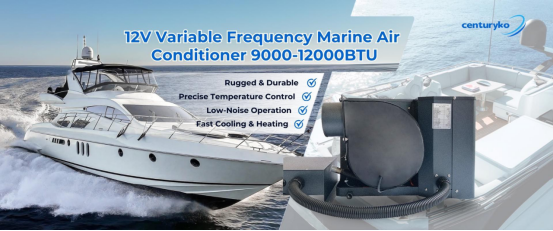
To truly grasp the capabilities of modern maritime climate control, one must examine the advanced engineering integrated into today’s leading units. A perfect example of this technological evolution is the flagship 12,000 BTU self-contained cooling and heating unit, a highly sought-after configuration in the commercial industry. Engineered for optimal durability, this specific unit utilizes premium titanium alloy conduits and full copper condensate tubes, ensuring it can process raw seawater without succumbing to internal corrosion. Additionally, it features an IPX4 waterproof-rated motor assembly (with key components meeting higher internal standards), an electrophoresis anti-corrosion fan, and a heavy-duty 304 stainless steel water tray. Beyond robust physical construction, it is designed for exceptional user comfort, operating at an ultra-low noise level of 42/52 decibels. Equipped with a smart control system that supports WiFi application management, users can remotely monitor five precision temperature sensors and control the raw water pump with seamless automation, maximizing both energy efficiency and onboard convenience.
Partner with ZhuoliMarine for Advanced Climate Solutions
As a technology-driven enterprise founded in 1997, ZhuoliMarine has established itself as a premier OEM and ODM manufacturer specializing in top-tier refrigeration equipment. With over two decades of dedicated expertise, they focus on delivering high-efficiency, customizable cooling and heating solutions designed specifically for personal yachts and large vessels. Their commitment to independent research and development has led to breakthroughs in intelligent frequency conversion control and low-temperature heat transfer optimization. By integrating strict quality control and cutting-edge automation, ZhuoliMarine consistently produces equipment that meets the rigorous demands of the global maritime industry.
If your business requires reliable, energy-saving, and ultra-quiet climate control technology, it is time to upgrade your vessel’s capabilities. Contact ZhuoliMarine today to explore their extensive range of customizable OEM and ODM solutions, and let their expert engineering team provide the perfect cooling system tailored to your exact specifications.
