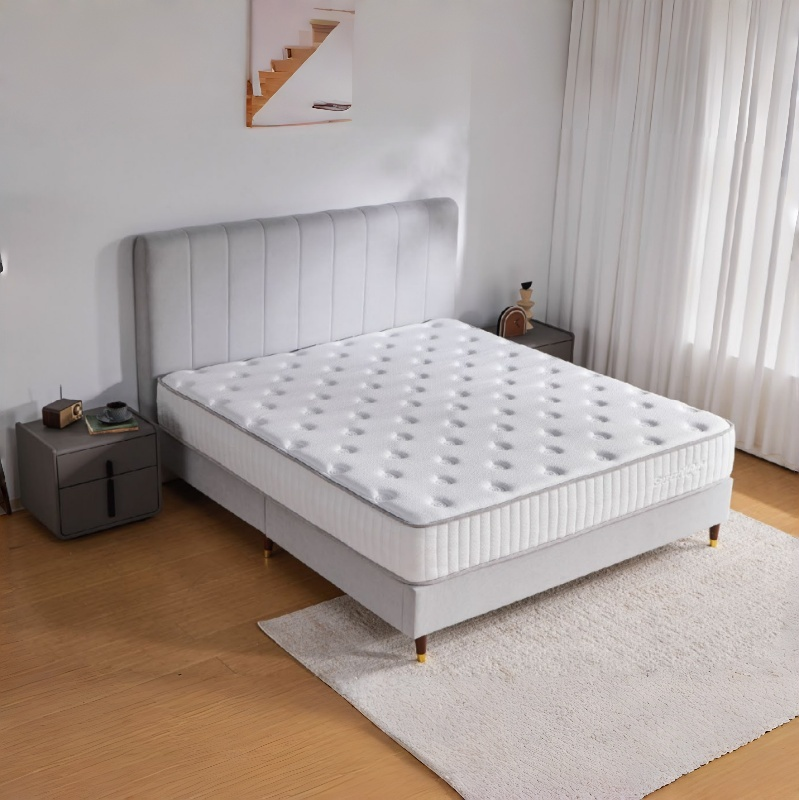
A mattress ordered by its nominal width and length may still fit poorly in the room where it belongs. A tight bed-frame opening, an unexpected mattress height, or a platform with a wide border can make a standard size unsuitable.
Hotels and residential projects face the same geometry problem, although the cost of a wrong measurement differs when one room or an entire property is involved. Custom sizing begins with the actual installation space, not with the name printed on a product catalog.
The purchasing decision is therefore about more than selecting a larger or smaller mattress. Measurements must be taken consistently, allowances must be defined, and the finished product must be checked against those values. The process is especially important when rooms use different bed bases or when replacement units must match an earlier installation.
Measure the Full Sleeping System
The relevant dimensions include the inside of the bed frame, the supporting platform, and the desired height of the sleeping surface. A width taken at the outer edge of a frame may not describe the opening into which the mattress must fit. Room access and the route to the bed can also affect how a large product is delivered. A useful drawing identifies the measurement points instead of listing three numbers without context.
Tolerance deserves a separate discussion. No production process produces an infinite level of precision, and soft materials may respond differently during packing and installation. The buyer and factory need an agreed range for length, width, and height. Without it, a unit can technically match a nominal catalog size while failing to fit a particular frame. The approved sample should be measured by the same method used for the delivery inspection.
Custom mattress manufacturers can work from these dimensions only after the project states which values are fixed and which may vary. Fabric, edge treatment, and construction can affect final height or perceived fit. Measuring the frame once and assuming every room is identical can conceal errors in renovation projects. Representative rooms or bed bases may need separate records.
The drawing gives context to Suisin Furniture‘s published offer to change standard mattress sizes to exact customer requirements. Its customization page describes OEM and ODM routes using existing designs with customer logos or customer-supplied styles and designs. Those statements make the company relevant to a non-standard size discussion, but the buyer still has to provide actual measurements, chosen construction, and approval criteria for the intended room.
Hotel and Residential Orders Have Different Risks
A hotel may repeat one approved size across many rooms, making a small measuring error expensive at scale. The room schedule should link each bed type to its approved mattress dimensions and distinguish any exceptions. A residential project may involve fewer units but more variation between individual spaces. Its challenge is often coordinating a custom mattress with a particular frame, bedding choice, and occupant preference. Custom mattress manufacturers need each room group linked to measurements.
An order for several dimensions needs clear model identifiers. Similar-looking units can be confused during production or installation if labels and room schedules are not aligned. The physical difference may be small, while the consequences are visible every time bedding is changed. The search phrase “custom size mattress manufacturers” may return many claims of flexibility; useful evidence is a specification and sample tied to each required size.
Approve the Fit Before Quantity Increases
A sample can verify more than feel. It can be placed in the intended bed base, measured after unpacking, and checked for the planned finished height. The review should note any gap, compression against the frame, or difficulty fitting sheets. These observations convert an abstract dimension into an installation decision. If the design changes, the sample reference and room schedule must change together.
Suisin Furniture’s reported design team of more than 50 engineers, three production bases, standardized lines, and repeated inspections provide questions to pursue about non-standard orders. Which team turns a measurement drawing into a production instruction? At what stage is height checked? How are different room sizes identified before packing? Those answers matter more to fit than a general statement that customization is available.
For larger projects, a trial installation can reveal a measurement problem before every unit is produced. Residential buyers can apply the same principle at smaller scale by testing the approved mattress in the actual frame. Custom size mattress manufacturers cannot correct a dimension that was measured from the wrong reference point. A successful size program depends on shared measurements as much as the production capability of custom mattress manufacturers.
Fit Is the Final Specification
The goal of custom sizing is not novelty; it is a mattress that works with the bed and room for which it was ordered. Hotels need repeatable dimensions across room groups, while residential projects may need precise adaptation to individual furniture. Both benefit from drawings, tolerances, samples, and a documented approval before bulk production.
The installed bed frame exposes errors in agreed measurements. Actual measurement at installation confirms whether the delivered mattress fits the bed frame and the room specification approved for that property.
