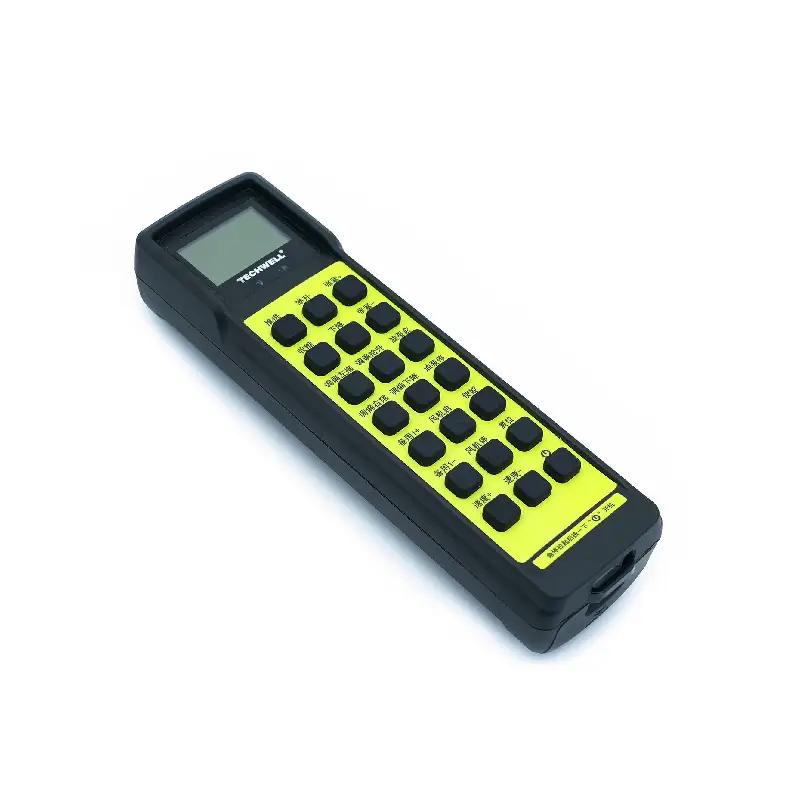
Operating a hoist from a fixed pendant station means standing wherever the cable happens to reach — not necessarily where the operator can actually see the load best. Wireless control removes the physical constraint imposed by the pendant cable. Once the transmitter isn’t tethered to the machine, the operator can reposition within the system’s operating range to find a suitable view of the lift and surrounding area. That added mobility is one reason wireless control can be useful for hoist applications where operator positioning matters.
The Positioning Problem with Wired Pendants
A wired pendant limits the operator’s movement to the length and routing of its control cable, which can restrict positioning around a hoist. On a busy job site, this fixed operating position may leave the operator near the load path, in a blind spot, or behind surrounding equipment that obstructs visibility. Wired systems also introduce physical hazards of their own, including cables that can become caught, suffer wear, or create tripping risks across the work area.
Replacing a wired pendant with a wireless system removes the physical cable connection and gives the operator greater flexibility to choose a suitable operating position as lifting work progresses. However, the practical benefit depends on more than the transmitter. The receiver, its communication performance, and its compatibility with the hoist’s control architecture all influence how the system operates.
What the Receiver Does to Enable This Freedom
The transmitter often receives the most attention in a wireless hoist system, but the receiver mounted on the hoist is equally important. It receives wireless commands from the transmitter and converts them into output signals that the hoist’s control system can process. The available functions depend on the receiver’s output configuration and its compatibility with the machine.
Techwell’s industrial remote control receiver range includes options for different control requirements, from basic relay switching to bus-based communication. For straightforward hoist applications involving raise, lower, and stop commands, the MM100 and MM200 provide relay-based on/off outputs through UHF communication. Both models use fixed factory settings, while the MM200 additionally features frequency-hopping anti-interference technology. These models are intended for applications where relay switching is sufficient, rather than installations that require more extensive communication integration.
Signal Range and How Far Positioning Freedom Extends
Operator positioning is only as flexible as the wireless communication range allows. The MP200 receiver from Techwell Remote Control is designed for joystick and mixed-switch control and supports a listed wireless range of at least 150 meters. This provides a reference when assessing whether operators can reach suitable positions within the intended working area.
The specified range should not, however, be treated as a guaranteed operating distance at every job site. Buildings, metal structures, heavy machinery, and radio-frequency interference can affect actual communication performance. When evaluating a wireless hoist system, buyers should consider the site’s layout and potential obstructions alongside the stated range. A practical assessment of the working area can help determine whether the selected system provides sufficient coverage for the intended lifting tasks.
Integration with Existing Hoist Control Systems
Greater operator mobility is useful only when the wireless system can communicate correctly with the hoist’s existing control architecture. Receiver output type is therefore an important selection factor, particularly for equipment connected to a programmable logic controller (PLC) or other industrial control equipment.
For more complex integration requirements, Techwell’s ML300 receiver supports digital I/O, PWM, serial communication, and industrial communication protocols including PROFIBUS DP, PROFINET, EtherNet/IP, and Modbus TCP. PROFIBUS DP is a fieldbus protocol, while PROFINET is based on industrial Ethernet. The ML300 also provides an on-site screen menu for configuration. These capabilities may be relevant to hoists that need to exchange control signals with an existing PLC system, provided the receiver interface is compatible with the machine’s architecture.
The MP300 offers a more compact CANopen-based option for installations where a bus-oriented receiver is required and available mounting space is a consideration. The choice between these models should be based on the required communication interface, control signals, and transmitter compatibility rather than physical size or feature count alone.
Anti-Interference Performance for Reliable Positioning
Wireless positioning depends on maintaining communication between the transmitter and receiver as the operator moves around the work area. Intermittent signal disruption can interrupt commands and reduce the practical value of remote operation, particularly in industrial environments where multiple machines and radio-frequency devices may be active at the same time.
Techwell’s MM200 uses frequency-hopping anti-interference technology as part of its communication design. This gives it a different interference-management approach from the MM100, which uses UHF communication and an anti-interference design without the same specifically stated frequency-hopping feature. The distinction may be relevant when comparing receiver options for sites with potential radio interference. Nevertheless, actual performance depends on the installation environment, frequency configuration, and operating conditions. Buyers should assess the site’s radio environment rather than assume that any single receiver feature will eliminate interference.
Matching Receiver Choice to Hoist Complexity
Not every hoist installation requires the same receiver configuration. Equipment with basic lifting and lowering functions may be adequately served by relay-output models such as the MM100 or MM200. Applications involving joystick operation, CANopen communication, or PLC integration may require a receiver with a different output interface, such as the MP200 or ML300.
The selection process should begin with the hoist’s control requirements. Buyers should confirm the number and type of required commands, the receiver’s output method, the transmitter-receiver compatibility, the available power supply, and the environmental conditions at the installation site. Protection ratings and operating temperature ranges should also be checked against the specific model’s technical documentation.
For safety-related applications, it is important to distinguish between an individual receiver’s stated safety-related characteristics and the safety performance of the complete hoist control system. The receiver alone does not establish the safety level of the entire machine. System-level assessment must consider the relevant components, control architecture, safety functions, and applicable standards.
Conclusion
Wireless hoist remote control depends on the compatibility of the transmitter, receiver, and machine control system. While wireless operation gives operators more flexibility than a cable-connected pendant, the practical benefits depend on the receiver’s output configuration, communication performance, and integration with the existing hoist architecture. Techwell Remote Control offers options such as the MM100 and MM200 for basic relay-based functions and the MP200 for joystick and CANopen-based applications. Evaluating these models against the equipment’s actual control requirements and verified compatibility information provides a more appropriate basis for selecting a wireless hoist control system.
