Camping power needs have changed as outdoor equipment becomes more capable. Refrigerators, lighting, communication devices, cooking equipment, and other electronics can all require dependable electricity away from the grid. For business buyers evaluating portable power equipment for outdoor applications, choosing among inverter generators for camping requires more than comparing headline wattage. Noise, fuel efficiency, runtime, portability, durability, and safe operation can all influence whether a generator performs well in real camping environments.
Start with the Right Power Capacity
The first consideration is whether the generator can handle the intended electrical load. Buyers should calculate the running wattage of the equipment that will operate simultaneously and consider starting requirements for appliances with motors or compressors.
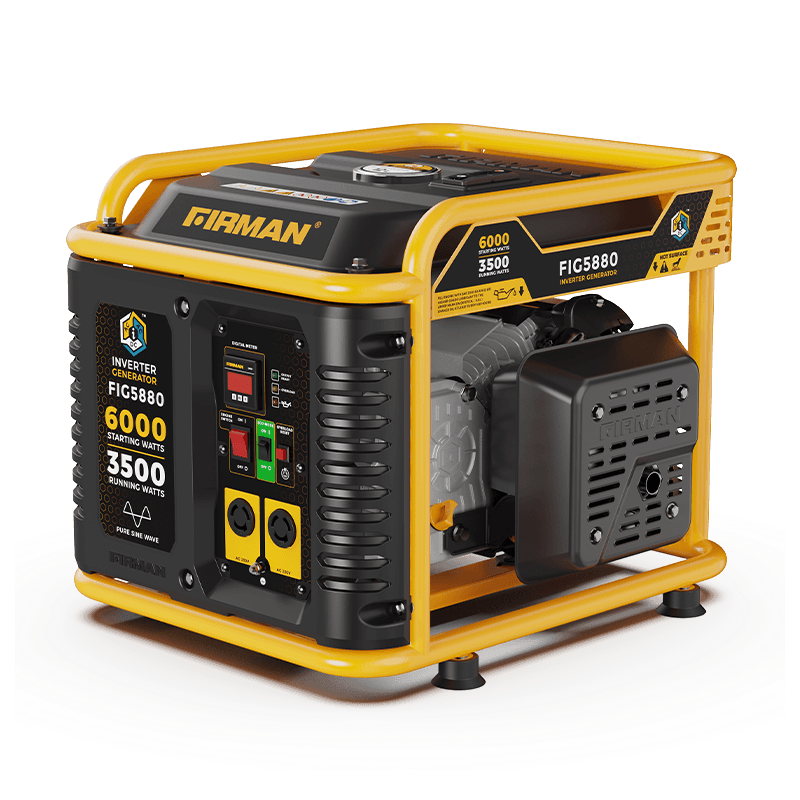
FIRMAN’s product portfolio includes multiple petrol generator options, from compact models to higher-output machines. FIRMAN FIG5880 is at 6,000W starting watts and 3,500W running watts.
For camping applications, this capacity can provide more flexibility than a very small generator when several devices need power at the same time. However, selecting a larger model than necessary can increase transport and fuel requirements, so load planning remains important.
Noise Matters at a Campsite
A generator that is technically powerful but excessively noisy can reduce the practicality of outdoor power. Campsites are often shared environments, and continuous engine noise may disturb nearby campers or interfere with conversation and rest.
Noise performance should therefore be treated as a purchasing criterion rather than an optional feature. The FIG5880 features a low-noise design rated at 64dB(A) at 7m under 25% load, making it well-suited for noise-sensitive applications.
For professional buyers, this specification also provides a measurable reference when comparing equipment for camping programs, outdoor events, rental fleets, or other portable-power applications.
Fuel Efficiency Affects Operating Cost
Fuel consumption is another important factor when selecting a petrol generator for extended outdoor use. A generator that uses fuel efficiently can reduce refueling frequency and help users manage operating costs over repeated trips.
The FIRMAN FIG5880 is designed with an ECO mode that automatically adjusts engine speed according to demand. Its ECO FUELER system can reduce fuel consumption by up to 17% compared with standard generators and by 8%–20% compared with other inverter generators on the market.
Such a feature can be particularly useful when the connected electrical load varies throughout the day. Instead of operating continuously at a high engine speed, the generator can adjust output according to actual demand.
Runtime Should Match the Camping Schedule
Runtime determines how often users need to stop and refuel. For multi-day trips or outdoor operations, longer operation between refueling intervals can make power management considerably easier.
The FIG5880 features a 12L fuel tank, delivering up to 18 hours of runtime at 25% load and 11 hours at 50% load. These figures demonstrate why load level should always be considered when comparing generator runtime claims.
A buyer should therefore assess expected operating loads rather than relying on a single maximum runtime figure. Runtime typically varies with the connected load and operating conditions, so buyers should compare figures measured under equivalent conditions.
Portability Is More Than Wheel Size
Camping equipment must often be loaded into vehicles, moved around a campsite, and stored between trips. Generator weight and overall dimensions can therefore have a direct effect on usability.
FIRMAN describes the FIG5880 as approximately 10% smaller and 30% lighter than a standard generator with the same output, only 29kg net weight. This SPACE SQUEEZER design is intended to make transportation, storage, and deployment easier.
For business purchasers, compactness can also affect fleet management. Equipment that occupies less storage space and is easier to move may simplify logistics for outdoor service providers and organizations managing multiple portable power units.
Durability Matters for Repeated Outdoor Use
Camping equipment can face dust, movement, changing weather conditions, and repeated transportation. A generator intended for frequent outdoor use therefore needs more than convenient dimensions.
The FIG5880’s RUGGED Soldier design uses industrial-grade materials and has been tested through 1,000 hours of continuous operation. Such durability-oriented testing can be relevant for buyers assessing equipment for repeated commercial or recreational deployment.
At the same time, durability should not replace proper maintenance. Users should follow the manufacturer’s operating instructions, maintenance schedule, fuel requirements, and storage recommendations.
Safe Operation Must Remain a Priority
No discussion of inverter generators for camping is complete without addressing carbon monoxide. Petrol-powered generators produce exhaust containing carbon monoxide, an odorless and potentially fatal gas.
The CDC recommends operating portable generators outdoors more than 20 feet from windows, doors, and vents. The exhaust should be directed away from these openings. Generators should never be operated inside tents, campers, garages, or other enclosed spaces.
Campsite operators and professional buyers should also review local requirements and the generator’s instructions before deployment. Correct placement, ventilation, electrical connections, refueling practices, and routine inspection all contribute to safer operation.
Making the Right Generator Choice
The best camping generator is not necessarily the model with the highest output. A practical purchasing decision should balance power capacity with noise, fuel consumption, runtime, portability, durability, and safety.
FIRMAN offers a broad power-equipment portfolio that includes petrol generators and dedicated inverter generator models, giving buyers several capacity and application options. The FIG5880 stands out for buyers seeking a portable petrol-powered solution with 6,000W starting watts, 3,500W running watts, fuel-saving operation, extended runtime, and reduced operating noise.
For business purchasers, these characteristics can make the evaluation more systematic: first identify the load, then compare operating costs, mobility, noise performance, expected duty cycle, and safety requirements. This approach helps ensure that the selected generator supports the actual demands of camping and outdoor power applications rather than simply meeting a specification on paper.
A Practical Balance for Outdoor Power
Choosing inverter generators for camping ultimately requires a balance between electrical performance and practical field operation. A suitable petrol generator should deliver enough power without creating unnecessary fuel, noise, transportation, or maintenance burdens.
For buyers evaluating FIRMAN equipment, the FIG5880 provides a useful example of how these factors can come together in one portable power solution. Its output capacity, fuel-management features, noise performance, and portable design can be evaluated against the requirements of camping and other outdoor applications.
