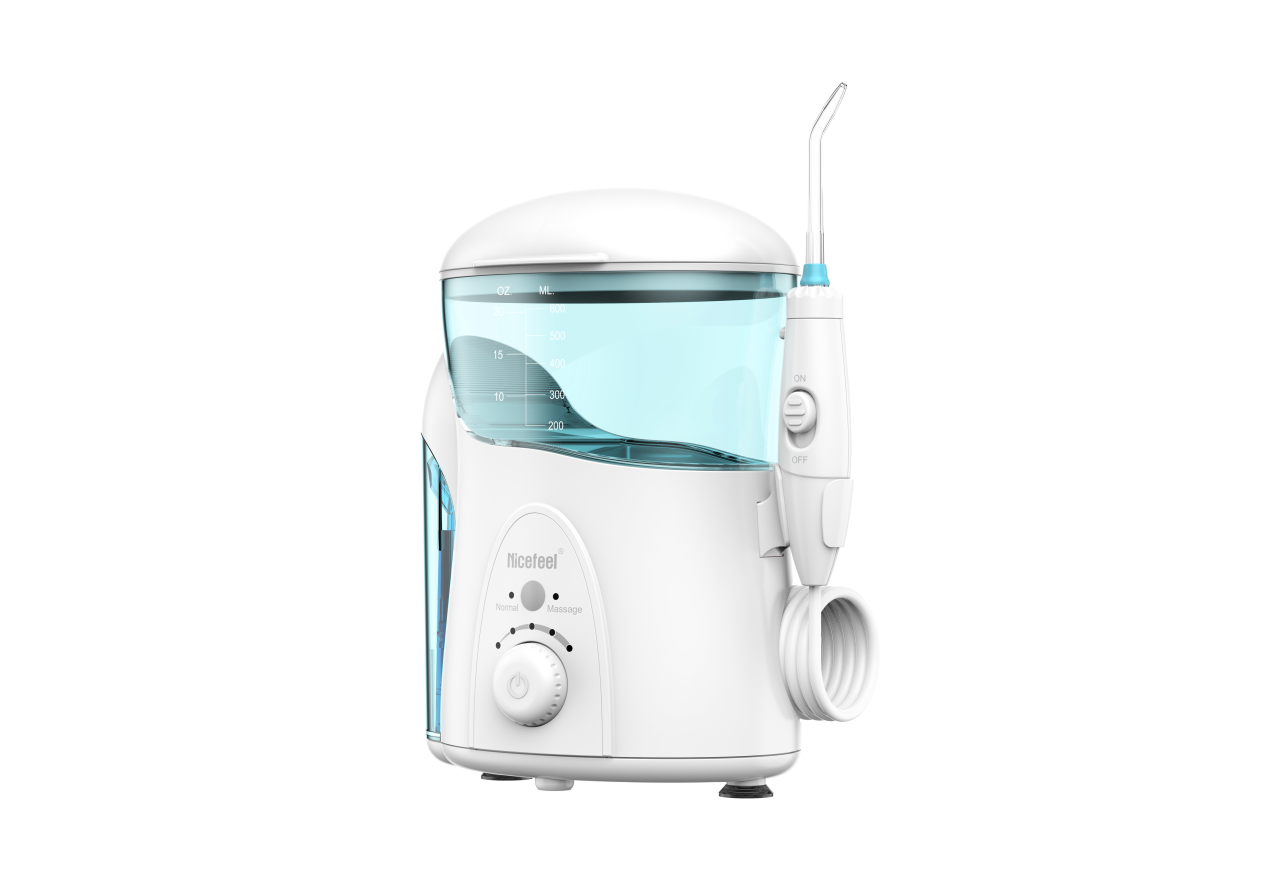
Bathroom space is becoming an important consideration when brands develop oral-care products. Countertop appliances need to deliver useful performance while fitting naturally around sinks, mirrors, cabinets, and other daily-use items. For this reason, countertop oral irrigator design should consider footprint, reservoir placement, cable management, controls, and cleaning access rather than focusing only on water pressure.
For brands targeting home users, these details can influence whether a product feels convenient enough for everyday routines. A well-designed water flosser countertop product should make setup, operation, refilling, and storage straightforward without occupying unnecessary bathroom space.
Footprint Should Match the Bathroom Environment
The first design consideration is overall footprint. A countertop oral-care appliance needs sufficient stability but should not consume excessive surface area. Designers should evaluate width, depth, and height together because a device that fits beside a sink may still interfere with cabinets or mirrors if it is too tall.
Placement also matters. The reservoir and handle should remain accessible without forcing users to move the entire appliance. For brands, reviewing the product’s dimensions alongside common bathroom layouts can help create a more practical countertop oral irrigator.
Reservoir Size and Refilling Convenience
Water capacity creates another design trade-off. A larger reservoir can reduce the need for frequent refilling, which is useful for regular household use, but it also requires more physical space. A smaller tank can create a slimmer product profile while increasing refill frequency.
The reservoir opening should also be easy to access and clean. Brands can consider removable or easily accessible tank structures that simplify routine maintenance. In a water flosser countertop design, water capacity should therefore be evaluated together with footprint, handling, and cleaning requirements.
Controls Need to Be Easy to Reach
Countertop products generally remain in one place, so controls should be positioned for easy access while the user is standing at the sink. Large knobs or clearly differentiated buttons can reduce unnecessary visual complexity.
Pressure adjustment is another important consideration. Users may prefer different settings, so accessible controls can provide useful flexibility. The American Dental Association recognizes water flossers as powered interdental cleaners, making ease of operation an important part of integrating the device into a consistent oral-care routine.
Cable Management and Storage
Power cords can quickly make a bathroom countertop feel crowded. Brands should consider where the cable exits the housing, how excess cable can be managed, and whether the appliance can sit securely without the cord becoming an obstacle.
Accessory storage is also worth planning during product development. Nozzles, handles, or other removable components should have a logical place when they are not being used. This can help keep the counter organized while making frequently used accessories easier to locate.
Noise and Daily Comfort
Countertop oral irrigators are typically used in close proximity to the user, so operating noise can affect perceived comfort. Noise specifications should be considered alongside motor performance, pressure settings, and overall product construction.
A lower stated noise level does not necessarily determine overall product quality, but it can be relevant for shared bathrooms or early and late daily routines. Brands should use verified test data when communicating noise performance rather than relying on subjective descriptions.
Cleaning Access and Water Management
Because these appliances handle water regularly, drainage and cleaning should be incorporated into the design from the beginning. Reservoirs, hose connections, and removable components should be accessible enough for routine maintenance.
Brands should also consider accidental splashing around the appliance. Waterproofing specifications provide a measurable reference, but the exact protection level should always be presented according to the manufacturer’s test conditions and instructions.
Flycat’s Countertop Product Options
Flycat provides a broad countertop range with different configurations for brands and distributors. Their official category includes models with 500mL, 600mL, and 1,000mL reservoirs, as well as different pressure ranges, operating modes, noise specifications, and waterproof ratings. This variety allows buyers to compare designs according to their intended market position.
For example, Flycat lists the FC288 with a 600mL water tank, 100–240VAC 50/60Hz input, 18W power, five pressure grades, a 30–125 PSI pressure range, flow of at least 290mL/min, and noise below 72dB. These specifications provide a useful reference for assessing the relationship between countertop functionality and physical product design.
Choosing a Practical Water Flosser Countertop Format
Flycat also offers the FC3680 with a 600mL tank, 18W power, high pressure of 80–120 PSI, low pressure of 20–50 PSI, flow of at least 290mL/min, seven standard jet tips, and IPX4 protection for the machine body and IPX7 for the handle. An automatic three-minute shutdown is also listed.
For B2B buyers, these differences show why countertop design should be matched with the intended user scenario. A family-oriented product may prioritize reservoir capacity and simple controls, while a space-conscious model may place greater emphasis on dimensions and storage. Product positioning should be based on verified specifications rather than generic convenience claims.
What Brands Should Prioritize Before Development
Flycat describes its business as an OEM/ODM partnership model for global brands, distributors, and healthcare companies, with integrated capabilities covering product development and mass production. Their stated manufacturing infrastructure includes a 20,000-square-meter facility, more than 30 production lines, and daily capacity of up to 30,000 units.
When developing a countertop oral irrigator, brands should therefore evaluate bathroom footprint, tank capacity, controls, cable management, accessories, cleaning access, noise, and waterproofing as one connected design system. Flycat’s range provides multiple specification configurations that can serve as references when comparing potential countertop solutions for different target markets.
