Preserving natural curl definition from one wash day to the next often depends heavily on your nighttime routine. Sleeping on standard cotton pillowcases exposes textured strands to constant friction, stripping moisture and breaking up curl clumps into stubborn frizz.
A satin bonnet for curly hair creates a smoother barrier between textured strands and the bedding. The key is knowing when to put it on, how to arrange curls inside it, and how to remove it without disturbing the pattern the next morning.
Why Curly Hair Needs Protection During Sleep
Curly hair patterns rely on uniform clumps of strands that twist and spiral together. When you toss and turn at night, rough bed sheets pull at these individual clumps, disrupting the natural alignment and creating morning bedhead.
Cotton fabrics can absorb more moisture than smoother satin surfaces, which may leave curly hair feeling drier and cause some leave-in products to transfer onto the pillowcase. Putting on a smooth satin cap before bed shields your curls from abrasive contact, helping you wake up with less frizz and better-defined coils.
Preparing Your Curls Before Putting on a Satin Bonnet
Putting a satin bonnet over very wet hair can flatten the curl pattern and keep excess moisture close to the scalp, which may feel uncomfortable overnight. For most nighttime routines, letting the hair dry fully or become only slightly damp before covering it is a more comfortable approach.
If your hair is medium-length or long, gather the curls loosely toward the top of your head, a technique commonly known as the pineapple method. Use a soft silk scrunchie to secure the hair loosely near the crown without creating tight dents or pulling at your roots.
How to Place Your Hair Inside the Bonnet Without Flattening Curls
Putting on your headwear correctly contributes to keeping your curl pattern remains uncompressed throughout the night. Follow these steps to position your hair safely inside a satin bonnet:
- Tilt your head slightly forward so your curls fall naturally away from your scalp and neck.
- Hold the open edge of the cap wide with both hands, starting from the nape of your neck.
- Scoop the gathered curls gently into the interior pouch of the cap, keeping as many strands as possible inside the rim.
- Pull the front band up over your forehead and position it comfortably along the hairline without putting pressure on the ears.
- Adjust the tie band so the cap feels secure without creating excessive pressure around the head.
Managing Sleep Position and Headwear Security
A bonnet that feels comfortable at bedtime may still shift during the night if the closure is too loose or too tight. The goal is to keep the cap secure while leaving enough room for curls to move freely inside.
If the cap features adjustable tie ribbons, tying them at the side or front of the head may reduce pressure from the knot against the pillow. A smooth silk or satin pillowcase can also provide a smoother surface if the bonnet shifts during sleep.
Your sleeping position can also affect how well your curls hold their shape overnight. Sleeping on the side or stomach may place more pressure on the bonnet and the curls underneath it, especially around the sides and back of the head. Keeping the bonnet slightly loose and leaving enough room inside can reduce compression, while a smooth pillowcase provides additional protection where the bonnet or hair may come into contact with the bedding.
Morning Routine: Taking Off Your Bonnet and Refreshing Curls
Removing the cap gently can help the curls regain volume after sleep. Gently slide the cap off backward rather than pulling it straight up, allowing your curls to tumble out naturally without friction.
Avoid touching or separating your curls immediately after removal. Give your hair a few minutes to settle, then gently shake your roots with your fingertips or tilt your head upside down to restore volume. If certain sections need a touch-up, lightly mist them with water or a curl refresher spray rather than brushing or combing the hair while it is dry.
What Makes a Satin Bonnet Work for Curly Hair?
Not every satin bonnet provides enough room for curls to move freely overnight. Hair length, density, and overall curl volume all affect how much interior space is needed, particularly for thick or tightly coiled hair.
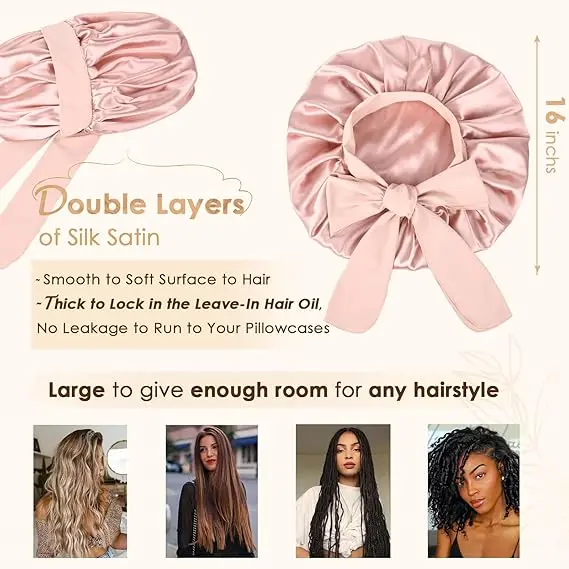
A roomy interior helps prevent curls from being compressed, while an adjustable tie band allows the bonnet to stay secure without creating excessive tension around the hairline. These details can improve both overnight comfort and the way curls look when the bonnet comes off in the morning.
Satin bonnet designs from YANIBEST feature adjustable tie bands that allow the fit to be adjusted for different hair volumes and styling needs. A secure closure, a comfortable band, and plenty of interior space work together to keep your curls safely covered without ever pressing them flat.
Ultimately, a good satin bonnet for curly hair should stay in place while giving curls enough freedom to retain their natural shape. The right combination of space, fit, and adjustability makes nighttime curl protection easier to maintain.
