Electricity cost accumulates over the entire route from charging a vessel to releasing an accepted batch. Equipment with less power may need a longer cycle, while poor circulation can leave material underprocessed and require additional mixing or rework. Running cost therefore depends on power, operating time, batch volume, process result, and losses around the cycle.
High shear batch mixers should be compared through the energy needed to produce conforming output. The relevant question for a batch high shear mixer is not simply how many kilowatts appear on the nameplate, but how the full process converts those kilowatts into saleable product.
Begin with Energy per Completed Batch
Electrical energy is related to power draw and operating time, so neither value should be reviewed alone. A higher-power unit completing the required duty quickly may use less total energy than a smaller unit running much longer, although actual draw and process conditions still need measurement.
Batch size also changes the useful comparison basis. High shear batch mixers should be evaluated in kilowatt-hours per completed batch or per unit of accepted output. A batch high shear mixer that misses the quality target cannot be considered efficient merely because its recorded electricity use is low.
Metered data should cover a representative cycle and identify the start and stop points used in the calculation. Comparing one machine’s full cycle with another machine’s motor-only interval would distort the result. Production volume and accepted yield should be recorded at the same time so that electricity use can be normalized without hiding rejected or incomplete material.
Let the Process Result Define the Required Work
Dispersion, emulsification, homogenization, and mixing do not impose identical treatment demands. Material viscosity, starting particle or droplet condition, solids content, and the required endpoint influence the intensity and duration of processing. The operating target should be measurable so that energy is not saved by stopping before the specification is reached.
High shear batch mixers need a defined product result and batch volume before their costs can be normalized. Each batch high shear mixer proposal can then be compared under the same formulation, endpoint, and production assumptions instead of a generic motor test.
Circulation Efficiency Changes Cycle Time
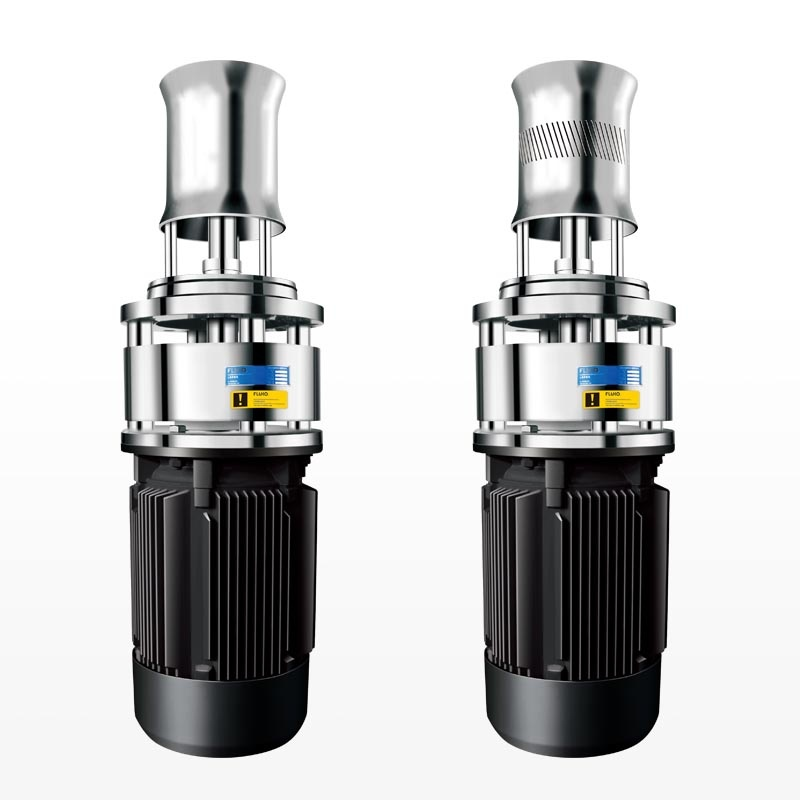
Material that returns consistently to the active region can reach the target more predictably than material trapped in weakly moving zones. Strong vertical circulation and shear turbulence are produced in the FJE/FJEX bottom-mounted design by a high-speed rotor and guide chamber; FLUKO positions this equipment for large vessels.
FLUKO states that its mixing efficiency is several times that of ordinary mixing equipment and that the design keeps energy consumption within a reasonable range. Those are manufacturer statements that require evaluation under the intended duty. They show why circulation belongs in comparisons of high shear batch mixers rather than being separated from the energy discussion around a batch high shear mixer.
Read Motor Power Speed and Capacity Together
Published ranges reveal how equipment is scaled for different duties. The FJE/FJEX series runs from 1.5 kW models for smaller applications to 55 kW models rated for as much as 10,000 L of water. FLUKO’s FAE/FME and related bottom-loading series also scale motor power and speed with maximum processing capacity.
These figures do not state the actual electricity use of every formulation, but they prevent mismatched size comparisons among high shear batch mixers. A batch high shear mixer should be placed beside the required fill volume, speed, expected cycle, and reference medium before running cost is estimated.
Count Cleaning Idle Time and Rework
The motor’s mixing period is only one part of the production cycle. Energy and operating cost may also arise during loading, recirculation, holding, cleaning, repeated sampling, and corrective processing. A poorly matched unit can add cost by extending labor time or producing a batch that must be mixed again.
Top-loading FM/FMB/FMS units in the FLUKO range extend from 0.75 kW at 30 L through larger configurations up to the FM/FMB/FMS 270 at 55 kW with a maximum water capacity of 6,000 L. That breadth lets high shear batch mixers be reviewed at an appropriate scale. The chosen batch high shear mixer still needs cycle data that includes nonproductive time and quality losses.
Rework deserves separate visibility because it repeats part of the energy and labor already spent on the batch. Cleaning frequency can also change with product sequence and campaign length. A cost model that records these events individually is easier to update than one average factor that conceals why two otherwise similar production periods consumed different amounts.
Use One Cost Basis for the Final Decision
Total cost per accepted batch provides the common denominator for the final decision. Its calculation includes required batch volume, measured or estimated power draw, processing time, circulation performance, cleaning time, labor exposure, and the probability of rework. Quality acceptance must remain the denominator so that incomplete processing does not appear economical.
Engineers can test alternative configurations against the same product and production schedule, then document assumptions that still require trials. High shear batch mixers create value only through conforming output at a sustainable operating cost. The soundest batch high shear mixer decision minimizes total cost per accepted batch rather than selecting the lowest nameplate power.
