Wind power converter platforms must manage fluctuating generator output, high electrical loads, and demanding operating conditions while delivering stable power to the grid. As turbine capacity increases, converter manufacturers face more complex requirements involving semiconductor selection, switching control, fault protection, and thermal monitoring.
Gate driver solutions play an important role in addressing these challenges. Firstack offers application-oriented driver architectures for SiC and IGBT power modules, helping engineers select suitable control and protection approaches for different converter topologies.
Addressing Different Converter Requirements with Application-Specific Solutions
Wind power converters use power semiconductor devices to regulate electrical energy between the generator, DC link, and grid. The selected topology and semiconductor technology influence switching behavior, system efficiency, insulation requirements, and protection strategies. Consequently, a single gate driver configuration may not suit every converter platform.
For manufacturers developing a wind power converter, the first consideration is compatibility between the driver and the power module. Voltage class, package type, gate voltage, output power, switching frequency, and topology all affect the selection process. Protection requirements also differ between two-level and three-level architectures.
Firstack’s portfolio addresses these differences through several application-specific solutions. The 2FHC06M33XX targets high-voltage SiC modules, while the ED-WP-CB supports IGBT-based three-level NPC and ANPC configurations. Together, these products illustrate different approaches to gate control rather than a one-size-fits-all design.
2FHC06M33XX: A SiC Solution for High-Voltage Two-Level Platforms
SiC MOSFETs are attracting attention in high-power conversion because of their switching characteristics and potential to reduce conversion losses. However, their fast switching behavior requires carefully coordinated gate control, appropriate voltage levels, and protection against unintended turn-on.
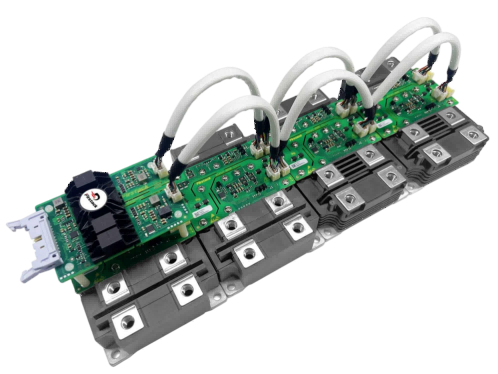
Firstack’s 2FHC06M33XX is designed for 3300V SiC MOSFET modules in LinPak, XHP-2, and LV100 packages. It supports two-level topologies and features a dual-channel electrical interface. Its specified gate-drive range is 15–20V positive and −2 to −8V negative, allowing engineers to configure the drive voltage according to the selected semiconductor’s requirements.
The architecture combines a main control core (MCC) with module adapter boards (MABs), connected through cables. It can flexibly match one to four compatible SiC or IGBT modules, depending on the configuration. Each channel provides up to 6W of output power at maximum ambient temperature, with an operating ambient temperature range of −40°C to 85°C.
Protection and monitoring functions include soft shutdown (SSD), undervoltage lockout (UVLO), Miller clamping, isolated NTC temperature sampling, and intelligent fault management. These features help address short-circuit events, unstable driver supply conditions, and unwanted gate activation. When selecting a SiC MOSFET gate driver selection, engineers can use these features as a starting point for evaluating high-voltage module compatibility and system protection.
ED-WP-CB: Coordinated Protection for Three-Level NPC and ANPC Topologies
Three-level Neutral Point Clamped (NPC) and Active Neutral Point Clamped (ANPC) topologies can help converter designers manage voltage stress and achieve different switching configurations. However, their multiple switching devices introduce more complicated turn-off coordination requirements. During fault conditions, incorrect switching sequences can increase voltage spikes and place additional stress on IGBT modules.
The ED-WP-CB addresses these challenges through a digital gate driver architecture developed specifically for NPC I-type three-level systems. It supports up to 1700V EconoDUAL IGBT power modules with a 15V turn-on gate voltage. The solution is also designed for multi-parallel NPC/ANPC configurations, making it relevant to renewable energy converters with demanding power-stage requirements.
A key feature is its CPLD-based digital control core. Combined with built-in fault management, this architecture handles critical switching sequences locally rather than relying entirely on the master controller. It addresses two important NPC I-type challenges: turn-off timing coordination and voltage spikes associated with large commutation loops.
The driver also monitors converter operating conditions and uploads relevant status information to the master computer in real time. Its protection functions include undervoltage protection, short-circuit protection through soft shutdown, and NTC temperature detection. This provides equipment manufacturers with additional support for fault diagnosis and maintenance planning.
For a wind power converter using parallel three-level IGBT arrangements, these functions offer a more coordinated approach to switching protection. The product specification lists 4W output power, a maximum switching frequency of 20kHz, and an operating temperature range of −40°C to 85°C.
Selecting and Integrating the Right Gate Driver Solution
Choosing a suitable SiC MOSFET gate driver or IGBT driver requires a system-level assessment. Engineers should first identify the semiconductor package, voltage class, topology, and switching requirements. They should then evaluate gate-voltage compatibility, protection timing, temperature monitoring, insulation, and communication interfaces.
Testing is equally important. Switching waveforms, short-circuit response, thermal behavior, electromagnetic compatibility, and parallel-device coordination should be validated under representative operating conditions. These checks help establish whether the selected driver can perform reliably within the complete converter system.
Firstack’s portfolio provides different solutions for two-level SiC and three-level IGBT architectures, allowing engineers to evaluate gate driver configurations based on their converter requirements. This product differentiation allows engineering teams to assess driver configurations according to their actual platform requirements rather than adapting a general-purpose solution to every application.
Matching Gate Driver Architecture to Future Wind Energy Needs
As wind energy systems continue to develop, converter manufacturers need gate driver solutions that address different semiconductor technologies and circuit topologies. Firstack‘s 2FHC06M33XX and ED-WP-CB provide distinct options for high-voltage SiC and IGBT applications. Whether evaluating a SiC MOSFET gate driver for two-level switching or an IGBT solution for multilevel configurations, engineers should prioritize module compatibility, coordinated protection, and validated operating performance. These considerations help build a reliable foundation for the next generation of wind power converter platforms.
