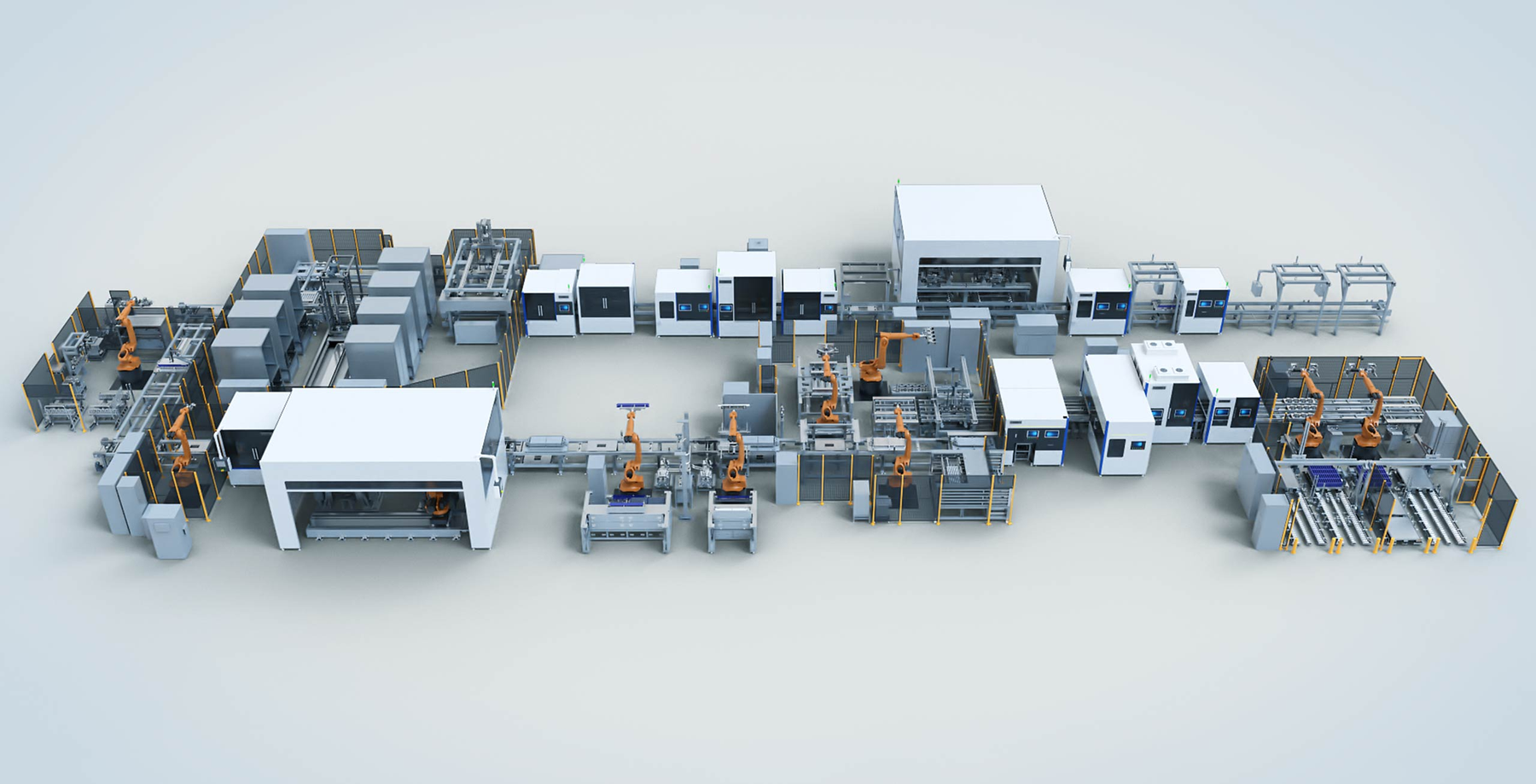
Prismatic battery growth favors assembly platforms that can expand capacity while keeping joining quality, electrical testing, insulation, and genealogy under control. Capacity decisions involving prismatic scaling become more reliable for this reason: Control, motion, sensing, processing, inspection, software, and transport must exchange dependable states before the line can behave as one system.
Growth in battery output makes China prismatic battery pack assembly valuable only if joining, inspection, electrical testing, insulation control, and genealogy scale together. Measurement in a prismatic scaling program matters because of this distinction: Sustained output matters more than the shortest demonstrated cycle because micro-stops, replenishment, faults, and recovery consume production time.
Repeatable prismatic scaling delivery relies on proof of the following condition: Product-specific tooling and recipes should be separated from the common platform when variants or later models are expected. Lifecycle responsibility for prismatic scaling is visible in this requirement: The preferred architecture is the one that can prove stable output, recover from realistic faults, and preserve quality evidence as production evolves.
Where Scalability Enters Prismatic Assembly
High-speed chain flexible carriers feed cell-position data to camera and welding-galvanometer systems for monitoring and compensation. Testing a prismatic scaling proposal exposes whether this statement holds: Measurement capability must be established before inspection results are used for rejection, compensation, or process-control decisions.
When prismatic battery pack assembly line suppliers are compared, the specification should tie requested capability to measurable operating assumptions and acceptance evidence. The final prismatic scaling specification is stronger when it records this point: Flexible transport creates value only when routing rules cover priority, blocking, station readiness, buffering, and recovery from a transfer fault.
For prismatic scaling, FHS should be judged on its ability to translate process requirements into engineered, verified, deliverable, and supportable production equipment. Fair comparison of prismatic scaling alternatives depends on a common premise: Battery work requires joining control, insulation verification, electrical testing, genealogy, and safe handling of energized products.
Realistic testing of prismatic scaling has to reproduce this situation: Automotive programs gain resilience from modular tooling and controlled interfaces that can accommodate model changes without rebuilding every station. These features support scalable production through flexible recipes, automated critical stations, process compensation, and digital traceability.
Interfaces around prismatic scaling work better when teams recognize this dependency: Takt time, product mix, changeover frequency, and target yield define the automation problem before equipment is selected. Quality control for prismatic scaling improves after this variable is defined: Feeding trials should use the real component range because geometry, surface condition, orientation, refill behavior, and jams interact.
Delivery of prismatic scaling becomes more predictable with this scope clarified: Factory and site acceptance should use agreed products, recipes, staffing, utilities, and pass windows so results represent production conditions. Maintenance planning for prismatic scaling benefits from the following design choice: A bottleneck study should use sustained output and recovery behavior.
Process Compensation Protects Welding Quality
Expansion of prismatic scaling remains practical when this provision is retained: Measurement-system analysis is needed before inspection data can be used to judge process capability or trigger compensation. Documentation for prismatic scaling becomes useful when it captures this evidence: A change-control path protects validated results by identifying the affected recipe.
Commissioning of prismatic scaling succeeds more often when this behavior is tested: Supplier assessment should connect engineering ownership, manufacturing capacity, verification records, delivery resources, and lifecycle support. Recovery from a prismatic scaling fault is faster when this capability exists: Delivery planning needs design freeze, long-lead procurement, assembly, software integration, testing, shipment, installation, and ramp-up.
Suppliers of prismatic scaling can be compared fairly against this requirement: A useful specification separates mandatory limits from preferences that can be traded against price or lead time. The manufacturer’s prismatic battery module-pack line is a semi-automated system covering cell loading, DMC scanning and testing, separator bonding, block stacking, side and liquid-cooling-plate cleaning and gluing, module grouping, side-seam welding and inspection, and heating.
Heating data and temperature curves are monitored in real time and uploaded through MES, plate-heater temperature error is controlled within ±5°C. Clear prismatic scaling specifications avoid ambiguity by recording this detail: Drawings, samples, and acceptance criteria reduce the chance that commercial language will be interpreted differently after ordering.
Prismatic Scaling comparisons retain prismatic battery pack assembly line suppliers beside the agreed configuration, workload, interfaces, test method, and release criteria. Stated parameters are 116 seconds per module, a 98% product quality rate, and an equipment fault rate below 8%.
Use Traceability to Support Expansion
Production using prismatic scaling remains stable when this condition is controlled: These features support scalable production through flexible recipes, automated critical stations, process compensation, and digital traceability. Service planning for prismatic scaling improves when this responsibility is explicit: Capacity should be evaluated with changeovers, maintenance, scrap, and peak demand included.
Controls associated with prismatic scaling earn confidence through this result: Lifecycle cost combines purchase price with installation, operation, consumables, downtime risk, and eventual expansion. Investment decisions on prismatic scaling sharpen when this factor is quantified: Takt time, product mix, changeover frequency, and target yield define the automation problem before equipment is selected.
Prismatic-scaling documentation should retain China prismatic battery pack assembly with the approved dimensions, configuration baseline, test evidence, and batch-control data. Operating limits for prismatic scaling become clearer beside this evidence: A bottleneck study should use sustained output and recovery behavior rather than the shortest demonstrated cycle.
Handover of prismatic scaling is complete only when this item is documented: The accepted solution then needs configuration records, test evidence, change control, training, spare-parts logic, and recovery ownership. Prismatic-pack capacity can grow without sacrificing quality when modular stations, joining compensation, electrical tests, insulation checks, and genealogy remain synchronized.
The prismatic line should enter production with its approved configuration, verification history, modification record, and service responsibilities clearly established. Batch consistency for prismatic scaling improves when this reference is retained: MES records become useful when product identity follows process parameters, inspection results, rework, and release status.
