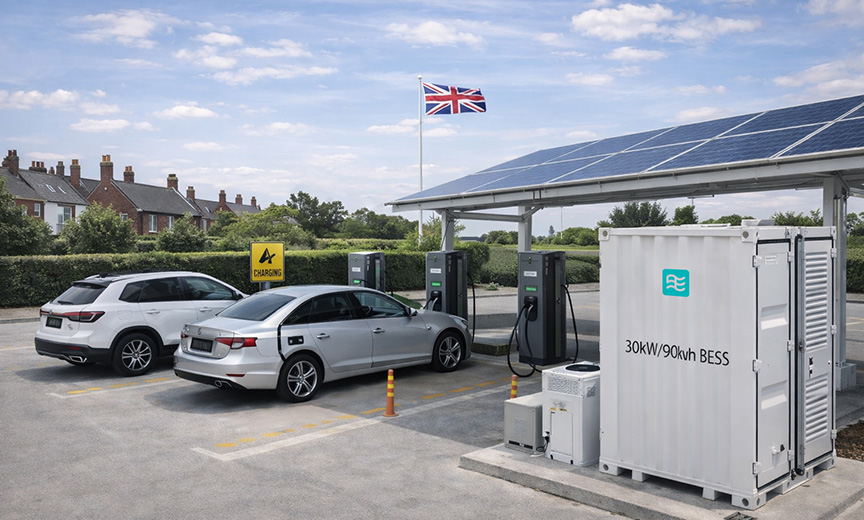
C&I energy storage is constrained as much by cabinet volume and heat rejection as by kilowatts. Commercial buildings, factories, and industrial campuses often add storage to existing electrical infrastructure, leaving limited space for converters, switchgear, cooling paths, and service clearances.
At the same time, the system may be expected to handle changing loads, renewable generation, backup operation, and future expansion. These pressures explain why the sic inverter is receiving greater attention.
A SiC inverter for C&I microgrids can change the trade-off among conversion loss, switching frequency, equipment size, and thermal design, giving system integrators additional options when fitting storage into constrained projects.
Power Density Has Direct Value in C&I Projects
Space pressure is often strongest in retrofits. A factory may have limited electrical-room capacity, an outdoor installation may have a restricted pad area, and a containerized project has fixed internal dimensions.
A SiC inverter for C&I microgrids can be attractive in these conditions because higher switching frequency can support more compact passive components and lower device losses can reduce part of the cooling burden.
Greater power density can translate into fewer cabinets or more conversion capacity within the same installation envelope. Transport and installation are affected as well. Cabinet dimensions determine door access, lifting requirements, aisle clearances, and the amount of field cabling between conversion equipment and the rest of the system.
A compact design can simplify those tasks, but serviceability still matters. Dense equipment needs accessible components, adequate airflow, and a maintenance plan that does not sacrifice long-term operability for a smaller footprint.
Grid-Forming Functions Add a Microgrid Requirement
C&I storage can serve more than tariff management. Some sites need backup during outages, operation beside weak utility networks, or coordination with diesel generation and renewable sources. WidenEdge’s MGC MK2 uses grid-forming control with VSG and droop functions, supports seamless switching between grid-connected and off-grid operation, and can handle 100% unbalanced loads in off-grid mode.
It also includes automatic response to load fluctuations, a synchronization interface, and diesel-generator control with parameter self-learning. For a SiC inverter for C&I microgrids, these functions place power density in a larger context. A compact converter is valuable only if it can also support the site’s electrical operating modes.
Storage equipment installed in a constrained commercial facility may still need to respond to motor loads, maintain local voltage and frequency during islanding, or coordinate with backup generation. Control capability therefore remains as important as semiconductor technology.
Why SiC Changes the Converter Design Trade-Off
Traditional silicon power devices have supported storage conversion for many years, but switching loss becomes a significant design constraint as frequency rises. Silicon carbide devices can switch faster with lower switching losses in suitable converter topologies, allowing designers to use higher frequencies without accepting the same loss penalty.
In a sic inverter, that capability can reduce the required size of certain inductors and filtering components while also lowering part of the heat generated by the power stage. The result is not automatically a smaller or more efficient cabinet.
Magnetics, cooling, protection, bus design, insulation, electromagnetic compatibility, and control all influence the final product. SiC mainly expands the engineering design space. It gives the converter designer more freedom to balance efficiency, power density, and thermal performance around the requirements of the actual storage system.
Thermal Margin Supports More Than Efficiency
Every watt lost inside a converter becomes heat that the enclosure must manage. Lower switching loss can therefore reduce thermal stress and create more margin before temperature limits force derating.
For a sic inverter used in a site with high ambient temperature or limited cooling, that margin can be valuable. It can also support more stable performance when the converter experiences repeated changes in load rather than operating at one constant power point.
Thermal design remains a system issue. High protection levels, dust exposure, humidity, and enclosure sealing can change how effectively heat is removed. Repeated load cycling can also produce changing thermal stress, so cooling capacity has to be considered across the expected operating profile rather than at one test point.
WidenEdge illustrates the environmental side of that design trade-off with its 100/150kW MGC MK2, whose high-protection structure is intended for demanding microgrid conditions such as islands and dusty environments. That product context shows why semiconductor choice and environmental design need to be evaluated together rather than treated as separate procurement items.
Why Attention Is Shifting Toward SiC-Based Platforms
At platform scale, the C&I value proposition extends beyond the inverter cabinet itself. WidenEdge combines full-SiC grid-forming PCS with battery storage, renewable generation, diesel generators, and local control for off-grid, weak-grid, and hybrid applications.
The significance for C&I projects lies in combining device-level benefits with system functions that affect installation and operation. A sic inverter can reduce power-stage losses and support higher power density, while modular and coordinated architectures can make storage easier to fit, expand, and operate inside existing facilities.
For space-constrained C&I sites, the case for SiC is strongest when lower converter loss and higher attainable power density ease installation and cooling constraints without sacrificing the grid-forming and backup duties the microgrid requires.
SEO Title: Why SiC Inverters Are Gaining Attention in C&I Microgrid Energy Storage Systems | WidenEdge
Meta Description: Read our latest insights on Why SiC Inverters Are Gaining Attention in C&I Microgrid Energy Storage Systems. Explore efficiency, density, and thermal margin.
