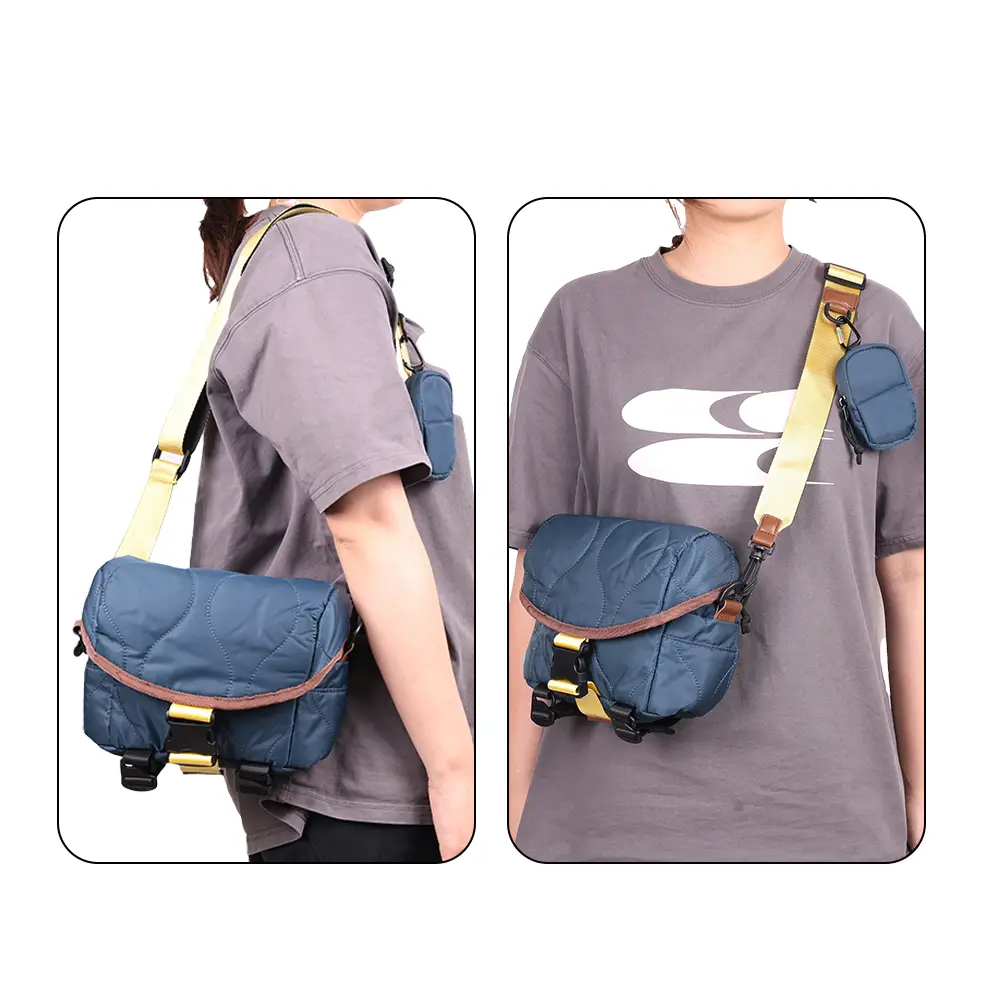
Capturing expansive landscapes or low-light scenes requires stabilizing equipment that rarely fits inside standard compact storage compartments. Photographers frequently encounter the challenge of transporting bulky carbon-fiber tripods alongside mirrorless bodies and delicate optical glass lenses. Innovative bag designers solve this spatial dilemma by incorporating adjustable bottom webbing loops and reinforced stabilization anchors into compact transport accessories.
Modern photography sling bags may incorporate external attachment systems for carrying compact tripods while keeping the main compartment accessible. Mastering these external carrying configurations allows visual creators to hike deeper into remote environments while keeping their hands entirely free.
The Spatial Dilemma of Transporting Tripods on Compact Slings
Carrying a rigid three-legged support system alongside sensitive camera bodies presents significant geometric challenges for single-strap transport accessories. Traditional internal storage chambers lack the vertical length required to house standard travel tripods without compromising space for vital lenses. Creators must look outward, relying on secure exterior mounting points that anchor long cylindrical objects firmly against the base of the bag. Industrial designers calculate center-of-gravity shifts carefully to ensure that external loads do not cause the entire sling to wobble during movement.
Engineers implement adjustable tension straps beneath the main compartment to accommodate varying tripod diameters securely without sagging. Selecting high-tenacity nylon webbing prevents straps from stretching or loosening under continuous vibration during long walking excursions. Proper placement and tensioning of external load loops can help keep the tripod close to the bag and reduce unwanted movement during walking. Selecting specialized photography sling bags equipped with these external mounting options transforms compact gear into a comprehensive field kit.
Mechanics of Expandable Bottom Webbing and Quick-Release Buckles
Securing a heavy metal or carbon-fiber tripod securely to the exterior of a mobile pack requires robust fastening hardware and adjustable tensioning loops. Quick-release buckles enable photographers to detach or attach their support systems in seconds without fumbling with complex knots or tangled straps. Heavy-duty tri-glide sliders allow users to tighten the webbing snugly around diverse tripod foot shapes and center column diameters. Hardware components can be evaluated through repeated fastening and adjustment tests to assess durability under regular use.
Material selection for these high-stress anchor points dictates the long-term reliability of the entire external carrying configuration. High-impact polyacetal plastics provide exceptional tensile strength and resistance against cracking under freezing sub-zero temperatures. ChangRong functional transform photography equipment integrates durable quick-release hardware designed to handle heavy daily field wear. Precision bar-tack stitching reinforces the webbing attachment zones, preventing tearing where the fabric meets the main body panel.
Weight Distribution and Balance During Dynamic Movement
Carrying an external load on the bottom of a single-strap accessory alters the natural pendulum motion of the bag against the torso. If a tripod hangs loosely, its momentum can pull the wearer off balance during brisk walking or uneven trail navigation. Designers combat this instability by adding secondary side compression straps that pull the upper portion of the tripod tight against the pack body. This dual-anchor stabilization keeps the entire setup rigid, preventing annoying bouncing and swinging motions during active transit.
Biomechanical studies show that a tightly secured external load reduces muscle fatigue by maintaining a uniform center of gravity along the spine. Creators moving through crowded urban environments or narrow mountain paths appreciate how stable mounting prevents accidental bumping into obstacles. ChangRong versatile multi-scenario gear utilizes balanced strap geometry to keep external equipment secure and close to the human frame. Proper weight management can help reduce localised pressure on the shoulders and hips during longer walks.
Fabric Durability and Abrasion Resistance at Base Panels
The bottom panels of outdoor transport accessories experience continuous friction against rough rocks, concrete curbs, and sandy ground surfaces. When a metal tripod head rubs repeatedly against the exterior fabric, weak materials will quickly fray, puncture, or tear open. Manufacturers apply high-density waterproof nylon and reinforced synthetic bottom boots to shield the gear from abrasive environmental hazards. These heavy-duty base materials also prevent moisture from seeping upward into the bag when placed on wet grass or mud.
Industrial coating techniques, such as heavy polyurethane layers, create an impervious barrier against water and dirt accumulation during outdoor shoots. A well-designed camera sling bag can incorporate reinforced base materials to improve durability in demanding outdoor conditions. Textile engineers test fabric tear strength rigorously to verify that external mounting points can support heavy loads without structural failure. Prioritizing robust base construction protects both the transport accessory and the expensive equipment attached to its exterior.
Versatile Storage Adaptations for Multi-Scenario Use
Modern visual creators demand gear that adapts fluidly between professional photography assignments, casual city commutes, and weekend travel excursions. When a tripod is not required for a specific outing, expandable bottom straps can be cinched flat against the bag to maintain a sleek profile. This transformable modular structure allows users to repurpose the lower exterior space for rolled jackets, umbrellas, or compact sleeping mats. Such flexibility maximizes the utility of a single accessory across diverse daily activities and environments.
Spatial adaptability eliminates the need for multiple specialized bags, offering a streamlined solution for minimalists and active explorers alike. Protective padding inside the main compartment can help protect camera equipment while exterior attachment straps are in use. A reliable camera sling bag combines this multi-scenario versatility with clean aesthetic lines suitable for professional and casual settings. Intelligent interior and exterior layout design empowers users to customize their carry setup instantly based on immediate situational demands.
Conclusion
External tripod attachment may seem like a simple strap addition, but beneath that woven nylon lies a careful orchestration of physics, material resilience, and user motion analysis. Every buckle, every bar‑tack stitch, and every bottom anchor point must work in concert to keep a carbon‑fiber tripod steady against the body—without throwing off balance or slowing down a decisive shot.
When these engineering details are executed with precision, they do more than just carry gear; they liberate photographers to move swiftly, climb higher, and frame with confidence. ChangRong embodies this holistic approach, integrating aerospace‑grade webbing, corrosion‑resistant hardware, and field‑proven abrasion shields into its sling designs. The result is a carry system that treats external equipment not as an afterthought, but as an integral part of the creative journey—allowing visual storytellers to focus on the frame, not the friction.
