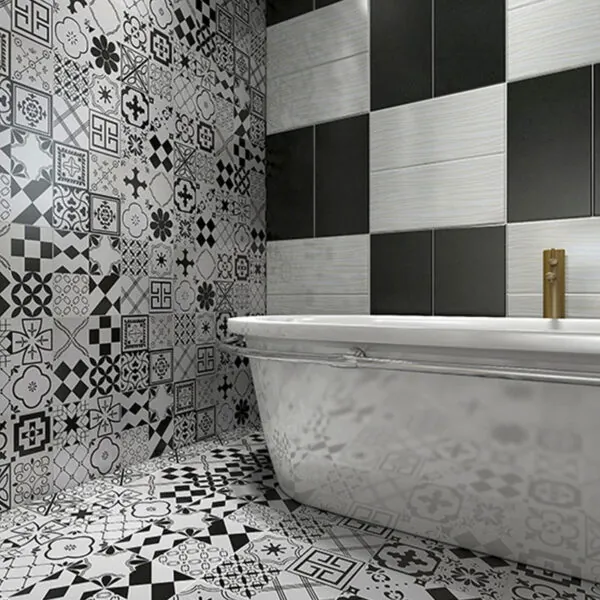
Bathroom flooring has evolved beyond purely functional surfacing into a deliberate design statement. While plain porcelain and ceramic formats remain practical defaults, an increasing number of homeowners and designers specify patterned bathroom floor tiles to introduce visual interest. These materials help define spatial zones and establish stylistic continuity with adjacent rooms.
The challenge lies in selecting patterns that complement rather than overwhelm a room’s proportions and existing fixtures. A Moroccan-inspired encaustic pattern in a compact powder room can feel claustrophobic if the scale is misjudged. Conversely, a subtle geometric motif in a spacious master ensuite might read as timid.
Understanding how pattern style, scale, color density, and material performance intersect with interior architecture is important. Careful planning is therefore required before finalizing any material orders. Project managers and homeowners should evaluate how different visual elements interact within the specific footprint of their washroom.
Why Patterned Floors Work in Bathroom Design
Patterned floor tiles perform a dual function in washrooms. They anchor the room’s visual identity while disguising the daily wear that typically accumulates in wet, high-traffic environments. Unlike wall patterns viewed at eye level, floor patterns are experienced from above and generally need to maintain coherence across the entire footprint. These decorative surfaces help establish a welcoming environment for users.
The key is selecting a pattern density that balances visual energy with the calming function a washroom serves. JLA Ceramics offers a dedicated collection of pattern tiles designed for various applications. Their range supports design professionals seeking to introduce patterned surfaces that maintain proportional harmony within both residential and commercial interior layouts.
Aligning Pattern Style with Bathroom Aesthetics
Different interior styles generally call for different pattern languages. Traditional and transitional spaces often suit classic encaustic patterns, damask motifs, or vintage floral repeats that reference historical tile craft. Contemporary or minimalist settings frequently benefit from restrained geometric grids, linear stripes, or monochromatic tessellations. Selecting the right motif helps unify the broader architectural vision of the property.
Eclectic interiors can often accommodate bolder, multicolor patterns with irregular repeats. The catalog from JLA Ceramics spans a wide range of stylistic references, from heritage-inspired designs to modern geometric formats. This breadth enables buyers to source patterned bathroom floor tiles that align with specific interior design vocabularies rather than settling for generic flooring alternatives.
Scale, Proportion, and Room Size
Pattern scale relative to room dimensions is a critical variable during the specification process. Large-format repeats in small washrooms can feel truncated and chaotic, as the motif rarely completes before meeting a wall or fixture edge. For irregularly shaped washrooms or those with multiple alcoves, simpler designs often adapt more gracefully.
Conversely, tiny tessera-style patterns in expansive areas might create excessive visual busyness that contradicts the intended sense of openness. A useful guideline suggests that pattern scale should relate to room dimensions: larger patterns may feel truncated in compact spaces, while fine repeats can introduce excessive visual density in expansive areas.
This dimensional flexibility allows specification across compact guest bathrooms, standard family layouts, and large master suites while respecting proportional relationships between pattern and architecture.
Material Performance and Slip Resistance
Washroom flooring needs to perform reliably under wet conditions, making material selection inseparable from aesthetic choices. Porcelain and ceramic options with textured or matte surfaces generally provide better traction than high-gloss formats. For patterned designs, the glaze application should be uniform to prevent uneven wear that could distort the motif over extended periods.
Buyers should verify slip-resistance ratings and confirm suitability for barefoot wet areas. JLA Ceramics subjects every batch to quality checks covering surface durability, color consistency, and flatness accuracy. This systematic approach helps ensure that specified finishes perform predictably under the moisture and continuous foot traffic conditions typical of active washroom environments.
Color Density and Visual Temperature
The color density of a floor pattern significantly affects perceived room size and atmosphere. High-contrast, multicolor patterns advance visually, making floors feel closer and spaces more intimate. This effect works well in large washrooms but can compress smaller ones. Soft, low-contrast patterns in muted tones tend to recede, creating an impression of an expanded floor area.
Cool color palettes reinforce a refreshing atmosphere, while warm terracottas introduce coziness. The pattern tile range from JLA Ceramics includes options across the color spectrum, from understated neutrals to more saturated statement designs. Buyers can select color densities that suit both the spatial proportions of their project and the specific atmospheric quality they intend to establish.
Layout Planning and Pattern Continuity
Patterned floor installations demand meticulous layout planning compared to plain formats. Professional installers typically establish a starting point that centers the design within the room while accounting for fixture footprints. Vanities, toilets, and shower enclosures interrupt the field, requiring careful alignment. Directional motifs should align with the room’s primary axis.
Non-directional patterns offer more layout forgiveness. Transition thresholds to adjacent flooring materials also require careful pattern termination to avoid visually jarring edges. JLA Ceramics provides technical support to help buyers achieve professional results with complex layouts. The team assists with installation recommendations that help buyers coordinate tile layouts with project-specific architectural conditions.
Sourcing Patterned Bathroom Floor Tiles for Your Project
When specifying patterned bathroom floor tiles, buyers should evaluate suppliers on color consistency across batches and pattern registration accuracy. Requesting physical samples is highly recommended, as digital catalogs rarely convey how a design reads under specific lighting. A supplier with documented quality systems reduces the risk of receiving batches with color drift or pattern misalignment.
JLA Ceramics is a professional wall and floor tile manufacturer based in Foshan, China. The company offers an extensive patterned collection alongside custom design and OEM services. With advanced production experience and extensive export expertise, JLA Ceramics supplies reliable flooring options that meet both aesthetic and functional requirements for residential and hospitality projects worldwide. To browse the full pattern collection or discuss custom design capabilities for your next project, visit JLA Ceramics.
