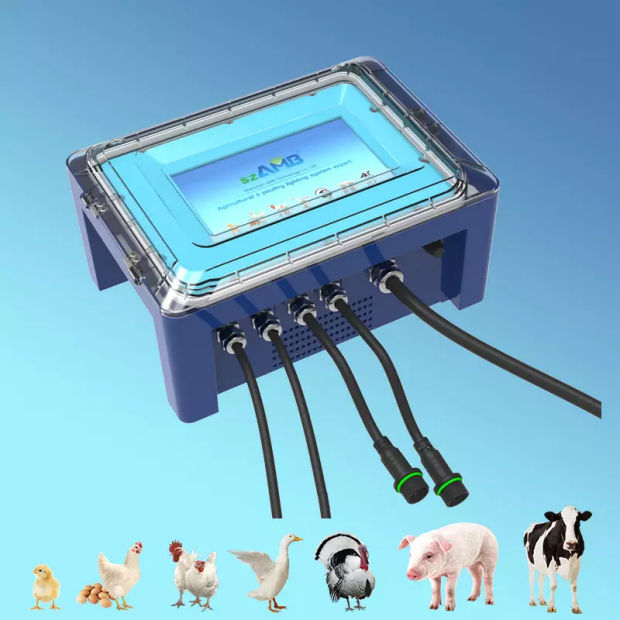
In the world of commercial agriculture, lighting is far more than just illumination; it is a sophisticated management tool directly impacting animal welfare, growth cycles, and profitability. For large-scale facilities like poultry house led bulbs farms, controlling thousands of fixtures uniformly is a critical challenge. This is where the master and slave controller system—often referred to as a dimmer master slave configuration—provides the backbone of intelligent environmental management.
The master and slave controller system is a centralized architecture designed to ensure absolute synchronization and precise control across an entire network of lighting fixtures. In this model, one designated device, the Master Controller, is the central command unit, setting the exact parameters (intensity, spectrum, and schedule). Every other connected device, known as a Slave Dimmer or Slave Unit, receives and flawlessly executes the Master’s commands.
This B2B solution is essential for modern poultry and livestock operations because it eliminates the potential for inconsistency—a single dark spot, an unexpected flicker, or a slight intensity variation in a large barn can cause bird clustering, stress, and behavioral issues like pecking, directly affecting mortality rates and production efficiency.
The Core Function: Ensuring Uniformity and Precision
The primary function of the dimmer master slave setup is to transform a complex electrical environment into a single, perfectly synchronized lighting zone.
The Role of the Master Controller
The Master Controller acts as the facility’s brain for the entire lighting system. This unit contains the digital intelligence, including a CPU, a user interface (often a capacitive touch LCD display), and the programmed schedule (the photoperiod, or “light recipe”). Its responsibilities include:
1. Programming and Scheduling: Setting the precise timing and ramp-up/ramp-down sequence for daily cycles (simulating sunrise and sunset).
2. Dimming Protocol Management: Converting the programmed light level into a uniform electronic control signal, such as 0-10V, Traic (Leading Edge), or BiMos (Trailing Edge) technology.
3. Command Distribution: Sending the precise signal simultaneously to all connected Slave Units.
The Role of the Slave Dimmer
The Slave Dimmer is the operational unit that receives the Master’s command signal and translates it into the actual power output to the fixtures. It handles the heavy lifting of adjusting the voltage or current provided to the hundreds or thousands of individual poultry house led bulbs to achieve the exact light level dictated by the Master.
In this setup, the farmer only needs to program the schedule on the Master Controller once. The system automatically ensures that the light intensity is uniform from the first bulb near the control panel to the last bulb hundreds of feet away, guaranteeing consistent animal environment management throughout the entire building.
Critical Benefits for Commercial Operations
For large-scale agricultural operations, the value proposition of a master and slave controller extends far beyond simple on/off switching. It directly impacts animal performance and the long-term ROI of the farm.
1. Optimal Animal Welfare and Reduced Stress
The szAMB Master & Slave systems are engineered for flicker-free, smooth dimming (0–100%). This smooth, gradual transition between light levels—what farmers call the “ramp-up” and “ramp-down”—is essential for simulating natural daylight cycles. Sudden changes in intensity are major stress factors for chickens, leading to aggression, hyperactivity, and poor feed conversion. A synchronized system minimizes these anomalies, leading to calmer flocks, lower mortality rates, and improved flock uniformity.
2. Scalability and Energy Management
Commercial barns can be hundreds of feet long and often require multiple lighting circuits. A quality dimmer master slave system is designed for scalability. A single Master unit can control multiple Slave units (channels), each capable of managing several hundred lighting fixtures.
For instance, the szAMB Smart Control System, depending on the model (e.g., AMB-IDS-4000-2C), can handle up to 4400W of load on a 220V system across two AC outputs, or, in the 0-10V system (e.g., AMB-IDS-2L), it can manage 25 dimmable drivers per output channel. This multi-channel capacity allows operators to create precise lighting programs for different zones within a large facility, such as brighter feeding areas and dimmer resting areas.
3. Disaster Preparedness: The Battery Back-up Advantage
In high-density commercial facilities, any sudden, unplanned power outage can be disastrous, often leading to flock panic and piling (suffocation). The most advanced systems integrate a Battery Back-Up RTC (Real-Time Clock) feature.
The szAMB Master & Slave Control system is equipped with this internal battery backup. This ensures that in the event of a power failure, the programmed schedule and dimming cycle—which are critical for maintaining the birds’ internal clocks—are not lost or affected. This eliminates downtime during the switchover to a backup generator or grid power restoration, maintaining the critical environmental stability for the flock.
szAMB Master & Slave Control: Precise Technical Specifications
As a leader in livestock lighting, szAMB provides intelligent dimming systems built specifically for the demands of the agriculture sector. The Master & Slave Control / Battery Back-Up units offer flexible dimming protocols to seamlessly integrate with various LED fixtures, ensuring maximum energy efficiency and productivity enhancements.
Key Features and Specifications
| Specification | Technical Detail (Example Models) | Benefit to Farmer (ROI Focus) |
| Dimming Technology | Triac (Leading Edge), BiMos (Trailing Edge), and 0-10V Input/Output Control. | Flexibility: Compatible with nearly all professional-grade LED drivers and fixtures, including those utilizing DC48V systems. |
| Smart Control | Built-in Digital CPU with smart timing and dim control; 7” 800x480px Capacitive Touch LCD. | Ease of Use: Allows scheduled programs (Broilers/Layers) or DIY setup, with transition time available for realistic daylight simulation. |
| Power Capacity (AC) | Up to 1100W (110V) or 2200W (220V) resistive load per 10A AC Output (e.g., AMB-IDS-2000-1C). | Scalability: Manages substantial electrical loads, suitable for large poultry houses with high-density lighting layouts. |
| Control Capacity (0-10V) | Up to 6 Output Channels (AMB-IDS-6L), each managing a maximum of 25 dimmable drivers. | Precision: Ideal for precise, low-voltage control over vast numbers of integrated LED systems, ensuring perfect synchronization. |
| Safety Feature | Battery Back-Up RTC. | Welfare & Safety: Guarantees lighting program integrity during power outages, preventing panic-induced mortality and maintaining production cycles. |
By utilizing a dedicated master and slave controller system, farm managers are able to move beyond simple automation to truly strategic environmental control. This level of precision is fundamental to unlocking the full potential of advanced poultry led bulbs technology, ensuring the best possible returns on investment while committing to the highest standards of animal welfare.
